

Most people assume the purpose of a financial plan is to grow their wealth. And to some extent, that’s true. Saving matters, investing matters, and making smart financial decisions matters.
But after years of working with people approaching and entering retirement, I’ve noticed something interesting: the conversations that matter most rarely revolve around investment returns. Instead, they sound more like, “Can we take the trip? Can we spend more time with the grandkids? Can I retire now? Will my spouse be okay if something happens to me? Can we help our children without hurting our own future?”
Those aren’t investment questions. They’re life questions. And they reveal something important. At some point, the purpose of a financial plan shifts. It stops being about growing money. And becomes about helping you live your life with greater confidence, flexibility, and genuine security.
Most People Spend Decades Building Wealth

For much of our lives, the objective is relatively straightforward: work, save, invest, build. That’s what we’re taught to do. The measuring stick becomes account balances, net worth, investment performance, and savings rates, and those metrics serve an important purpose during the accumulation years.
But eventually something changes. The focus begins shifting from “How much can I accumulate?” to “How do I use what I’ve built?” That’s a very different challenge, and it’s one that many people aren’t fully prepared for. We’ve written about this shift before in The Retirement “Number” Myth, if you want to see why the account balance alone rarely tells the full story.
The Goal Was Never the Account Balance
One of the biggest lessons retirement teaches is that money is rarely the ultimate goal. Money is a tool, one meant to support experiences, relationships, opportunities, security, freedom, and the people you care about most.
The challenge is that many people spend so long focusing on accumulation that they never stop to ask, “What is all of this actually for?” And without an answer to that question, it’s easy to keep chasing larger account balances while missing the point entirely.
Why Some People Struggle to Enjoy What They’ve Built
Over the years, I’ve met many people with substantial wealth who still hesitate to spend money. Not because they’re irresponsible, and not because they’re fearful, but because they’re uncertain. They’re unsure how much they can spend, whether the plan will hold up, what future taxes may look like, whether healthcare costs will derail things, and how market declines could impact them.
So instead of enjoying what they’ve built, they continue operating from a place of caution. They don’t necessarily have a money problem. They have a confidence problem. And confidence usually isn’t solved by adding more assets. It’s solved by having greater clarity. As we discussed in Why More Money Doesn’t Always Create More Confidence, the size of the number rarely fixes this on its own.
What a Good Financial Plan Actually Creates
Many people think a financial plan is designed to answer questions about money. A good plan certainly does that. But the best plans create something deeper.
Clarity. Understanding where income will come from, how taxes fit into the picture, how decisions affect one another, and what options exist moving forward.
Flexibility. Life rarely goes exactly according to plan. Markets change, health changes, and priorities change. A well-designed plan provides room to adapt without constantly feeling like you’re starting over.
Confidence. Not because every future outcome is known, but because you understand how the plan is designed to work and what adjustments may be available if circumstances change.
Ease. This is often what people are really searching for. Not more statements, not more projections, and not more complexity. The ability to enjoy life without constantly wondering, “Am I missing something?”
Why Integration Matters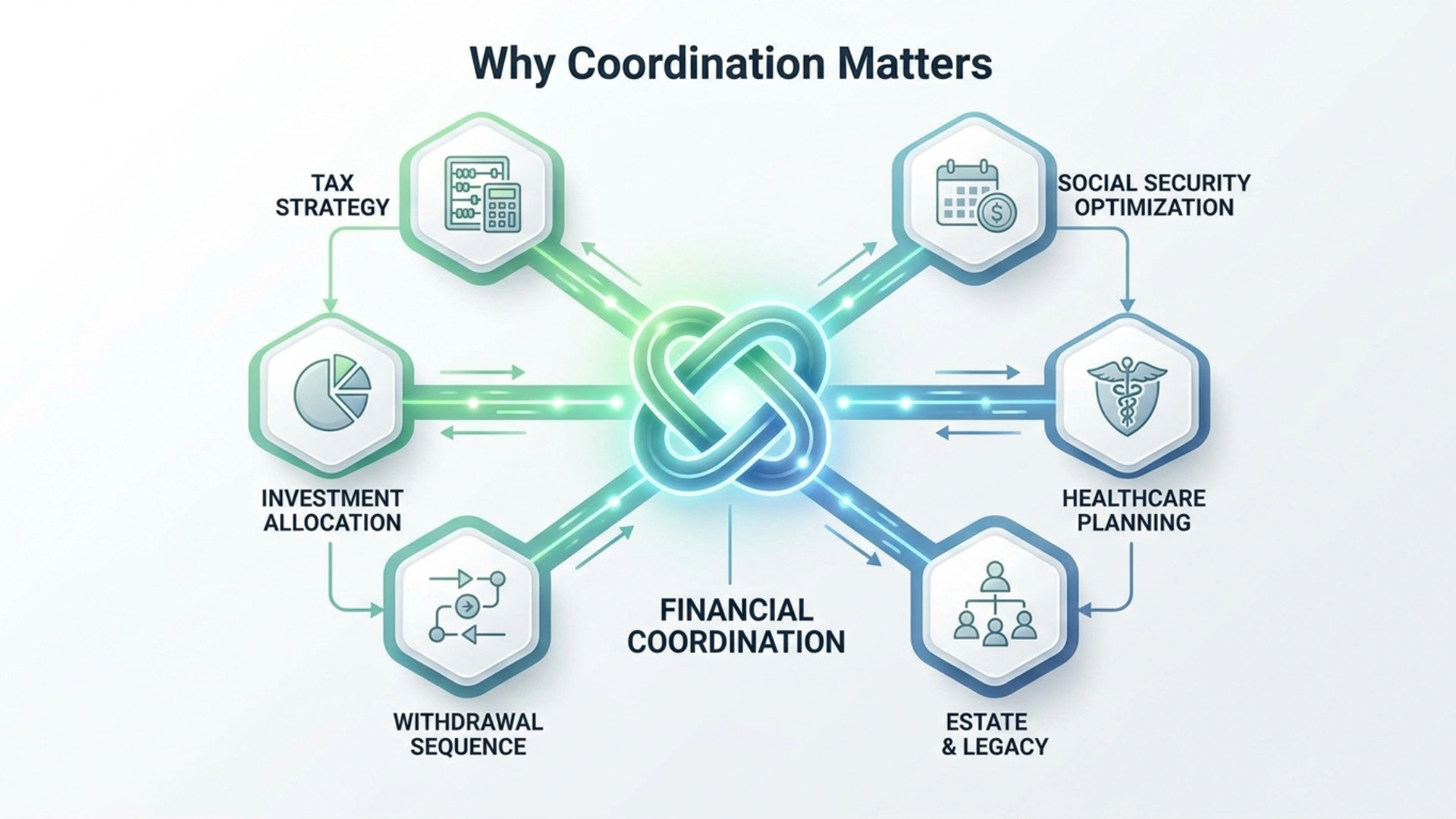
This is where many people discover the difference between having investments and having a plan. A portfolio by itself doesn’t answer when to take Social Security, how to manage taxes, how to structure withdrawals, how to plan for healthcare, how to leave assets efficiently, or how to balance today’s lifestyle with tomorrow’s needs.
Those decisions don’t exist in isolation. They interact. Income affects taxes. Taxes affect withdrawals. Withdrawals affect investments. Healthcare affects spending. Estate planning affects future generations.
The challenge isn’t understanding one decision. The challenge is understanding how all of the decisions work together. And that’s where a plan built as one integrated whole becomes so valuable.
The Ultimate Purpose
When people first begin saving, the objective is often simple: build wealth. But eventually the objective changes. The goal becomes creating a life that’s aligned with what matters most.
For some people, that’s travel. For others, it’s family. For others, it’s giving back, supporting causes they care about, or creating opportunities for future generations. The specifics are different for everyone, but the purpose is often the same: using financial resources intentionally to support a meaningful life.
A Final Thought
A financial plan should absolutely help your money grow. But that’s not its highest purpose. The real purpose of a financial plan is to help align your resources with the life you want to live: to create clarity where there’s uncertainty, flexibility where there are tradeoffs, and confidence where there are important decisions.
And ultimately, to create the confidence that allows you to enjoy what you’ve worked so hard to build.
Because at the end of the day, the goal isn’t to accumulate the largest possible account balance. The goal is to use the wealth you’ve built in a way that supports the people, experiences, and purposes that matter most. That’s what a financial plan is really for.