Most people know what a financial advisor does, at least they think they do. They assume the relationship revolves around investments, market performance, portfolio reviews, and annual meetings. And for many people, that’s exactly what their experience has been.
But as retirement gets closer, something starts to change. The questions become bigger. The decisions become more connected. And many people begin wondering whether they’re getting the level of planning they actually need. Not because their advisor has done anything wrong, but because retirement requires more than investment management alone.
Most People Don’t Realize What They’re Missing

One of the challenges in the financial industry is that many people have never experienced planning that was actually built as one plan. They’ve had investment accounts, annual reviews, and portfolio recommendations, so they naturally assume that’s what financial advice is supposed to look like.
And for someone who is focused primarily on accumulating assets, that may be enough. But retirement changes the equation. At some point the questions become less about “What should I invest in?” and more about “How do I turn everything I’ve built into a retirement that actually works?” That’s a very different conversation. If you’re wondering whether it’s time to ask that question, our advisor readiness checklist can help you think it through.
Retirement Shouldn’t Feel Like You’re On Your Own
One of the most common frustrations I hear from people approaching retirement is that they feel like they’re the ones trying to connect everything. They’re talking to an advisor about investments, a CPA about taxes, an attorney about estate planning, and an insurance professional about coverage. Everyone is helping within their area, but nobody seems to be looking at how those decisions affect one another.
As a result, many retirees find themselves playing the role of coordinator, and that’s a difficult position to be in when the decisions are becoming increasingly complex. A good planning relationship should reduce that burden, not increase it.
Good Advice Isn’t Just About Investments
Investments matter, and they always will. But most retirement mistakes don’t happen because someone picked the wrong mutual fund. They happen because important decisions weren’t connected: when to take Social Security, how to structure withdrawals, whether a Roth conversion makes sense, how future RMDs may impact taxes, how healthcare costs fit into the plan, and how estate documents align with financial goals.
These decisions often have a bigger impact on retirement outcomes than whether a portfolio earns slightly more or slightly less in a given year. And that’s why working with a financial advisor should feel like more than investment management. It should feel like someone is helping you understand how the entire picture fits together.
Your Advisor Should Be Helping You See Around Corners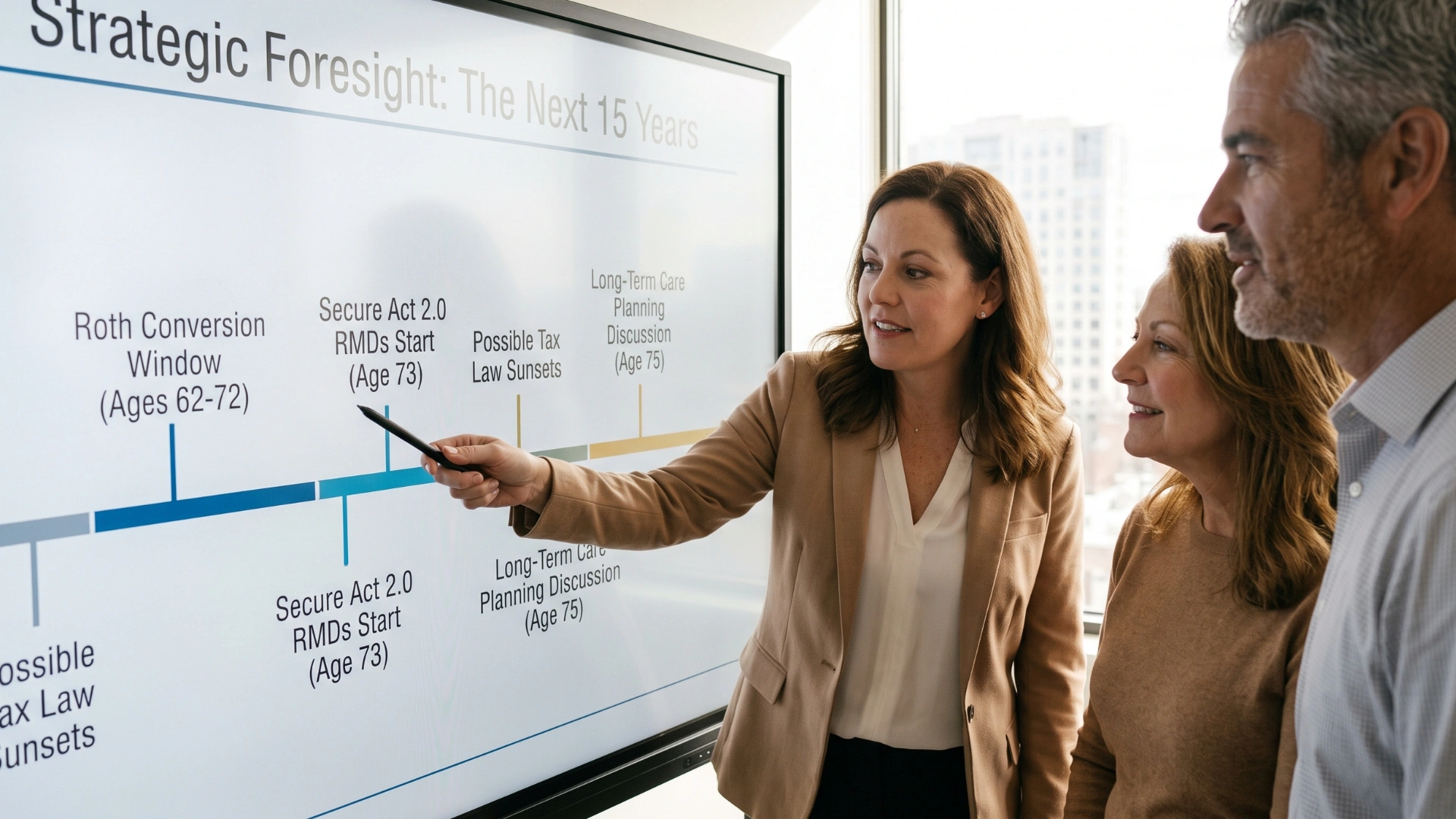
One of the most valuable things a financial advisor can do isn’t solving today’s problems. It’s helping you prepare for tomorrow’s decisions. The best planning conversations often happen before there’s an issue, before taxes become a problem, RMDs become mandatory, healthcare costs increase, market volatility creates stress, or estate complications arise.
Because planning is often at its most effective when action can be taken before the consequences appear. That’s one of the reasons retirement feels different from other stages of life. Many of the most important decisions need to be made years before their impact becomes visible.
Why Generic Advice Starts to Break Down
Part of the challenge is that much of the financial industry has been built around efficiency and scale, and scale often requires standardization: standardized portfolios, standardized recommendations, standardized processes. There’s nothing inherently wrong with that.
But retirement isn’t a standardized experience. Two people with identical portfolios can have completely different outcomes depending on their income sources, their tax situation, their health concerns, their family dynamics, their goals, and the decisions they make along the way. That’s where more personalized planning becomes important, because retirement isn’t experienced through a portfolio. It’s experienced through real-life decisions. We’ve made this same case before: retirement is rarely a straightforward investing problem.
What Integration Actually Feels Like
When people hear the word “integration,” it can sound abstract. In reality, it often feels simpler. A plan built as one integrated whole typically creates fewer surprises, fewer conflicting opinions, greater clarity around decisions, more confidence in future outcomes, and less wondering whether something important is being overlooked.
It helps answer questions like “How does this decision affect everything else?” instead of “What should I do right now?” That’s a meaningful difference. Because retirement isn’t a collection of isolated decisions. It’s a system, and systems work best when the pieces are designed to support one another.
More importantly, integration helps create something many retirees are ultimately looking for: Efficiency and Confidence.
Efficiency because decisions are made with an awareness of how they affect taxes, income, investments, healthcare, estate planning, and future withdrawals, rather than addressing each area separately. Confidence because you’re no longer wondering whether one decision is creating unintended consequences somewhere else.
When the pieces are aligned, people often feel more confident moving forward, not because every uncertainty disappears, but because they understand how the plan is designed to work and how future decisions fit within it.
What the Best Advisor Relationships Usually Have in Common
They aren’t built around products. They aren’t built around market predictions. And they aren’t built around chasing the highest return. Instead, they’re built around ongoing conversations about taxes, income, risk, family, healthcare, legacy goals, and the tradeoffs that come with each decision.
Because retirement isn’t static. Life changes. Priorities change. Laws change. And good planning adapts alongside those changes.
A Final Thought
A good advisor can help manage investments. That’s important. But retirement is rarely defined by investments alone. More often, retirement is shaped by how well income, taxes, withdrawals, healthcare, estate planning, and risk management work together over time.
And that’s why working with a financial advisor should feel like more than portfolio management. It should feel like having someone help you navigate the decisions that matter most, before they become problems.
Because the goal isn’t simply to manage money. The goal is to create one plan where income, taxes, investments, healthcare decisions, estate planning, and future withdrawals are designed to support each other, in a way that creates greater efficiency, confidence, and genuine security. And when that happens, retirement tends to feel less uncertain, less reactive, and far more clear.