

One of the most common assumptions people make going into retirement is this:
“When I need money, I’ll just take it out.”
On the surface, that feels simple and reasonable.
But in reality, how you take income in retirement matters just as much as how much you’ve saved.
Because once retirement begins, every withdrawal decision sets off a chain reaction:
● It affects your taxes
● It affects your portfolio balance
● It affects future income
● And over time, it affects how long your money lasts
This is where many retirement plans begin to drift—not because something obvious went wrong, but because no one ever connected how these decisions interact over time.
Most People Don’t Have an Income Strategy—They Have Habits

What typically happens in retirement is not a coordinated income plan.
It’s a series of defaults.
People tend to:
● Spend from cash first
● Pull from accounts as needed
● Or make withdrawal decisions one year at a time
None of these approaches are necessarily wrong on their own.
But they are incomplete.
Because they treat each decision in isolation—and in retirement, decisions don’t stay isolated for long.
Without coordination, something important gets left to chance:
How those decisions compound over time.
Where Income Comes From Is Not a Neutral Decision
Not all dollars are the same in retirement.
A dollar coming from:
● a pre-tax retirement account
● a brokerage account
● or a Roth account
will create very different outcomes.
That means:
● Taking income from the wrong place can increase taxes unnecessarily
● Taking income without a plan can push you into higher tax brackets
● And pulling from certain accounts first can limit flexibility later
This is where sequencing begins to matter.
Not in a theoretical sense, but in a very practical one:
The order you take income from changes the trajectory of your plan.
The Risk Most People Don’t See: Sequence of Returns
There’s another layer to this that doesn’t get talked about enough:
Sequence of returns risk.
This is one of the most important risks in retirement—and one of the least understood.
It refers to what happens when the market declines early in retirement, at the same time you are taking withdrawals.
Here’s the key concept:
It’s not just the return you earn—it’s when you earn it.
Two retirees can experience the same average return over time…
…but if one encounters losses early while withdrawing income, their outcome can be significantly worse.
Why?
Because withdrawals during down markets don’t just reduce your balance—they lock in losses.
You’re selling assets at lower values, leaving fewer assets behind to recover when the market improves.
A Simple Way to Think About It
Imagine two identical portfolios:
● Same starting balance
● Same long-term return
● Same withdrawal rate
But different timing:
● One experiences positive returns early
● The other experiences a downturn in the first few years
The second investor may:
● see their portfolio decline faster
● lose recovery potential
● and feel pressure much sooner
Even if markets recover later, the damage is already done.
This is what makes sequence risk so dangerous.
It doesn’t feel like a problem at first—but it compounds quietly.
Where Income Strategy and Market Risk Connect
This is where sequencing becomes more than just a tax discussion.
Because it’s not only about:
“Where should income come from?”
It’s also:
“How does that decision impact risk?”
When withdrawals are not coordinated, you may unintentionally:
● draw from growth assets during downturns
● increase exposure to sequence risk
● and reduce the resilience of the plan
On the other hand, when income is structured intentionally:
● different assets serve different roles
● short-term income needs can be separated from long-term growth
● and decisions can be made with both current and future years in mind
This is where planning begins to feel more stable.
What Happens Without a Coordinated Approach
Without an integrated income strategy, most plans don’t fail—they just become inefficient.
At first, things feel fine.
But over time, patterns start to emerge:
● Taxes are higher than expected
● Withdrawals feel less clear year to year
● Decisions become more reactive
● Flexibility begins to narrow
Nothing breaks all at once.
But the margin for error slowly tightens.
And that’s usually when people start asking:
“Am I doing this the right way?”
What a Thoughtful Income Strategy Actually Changes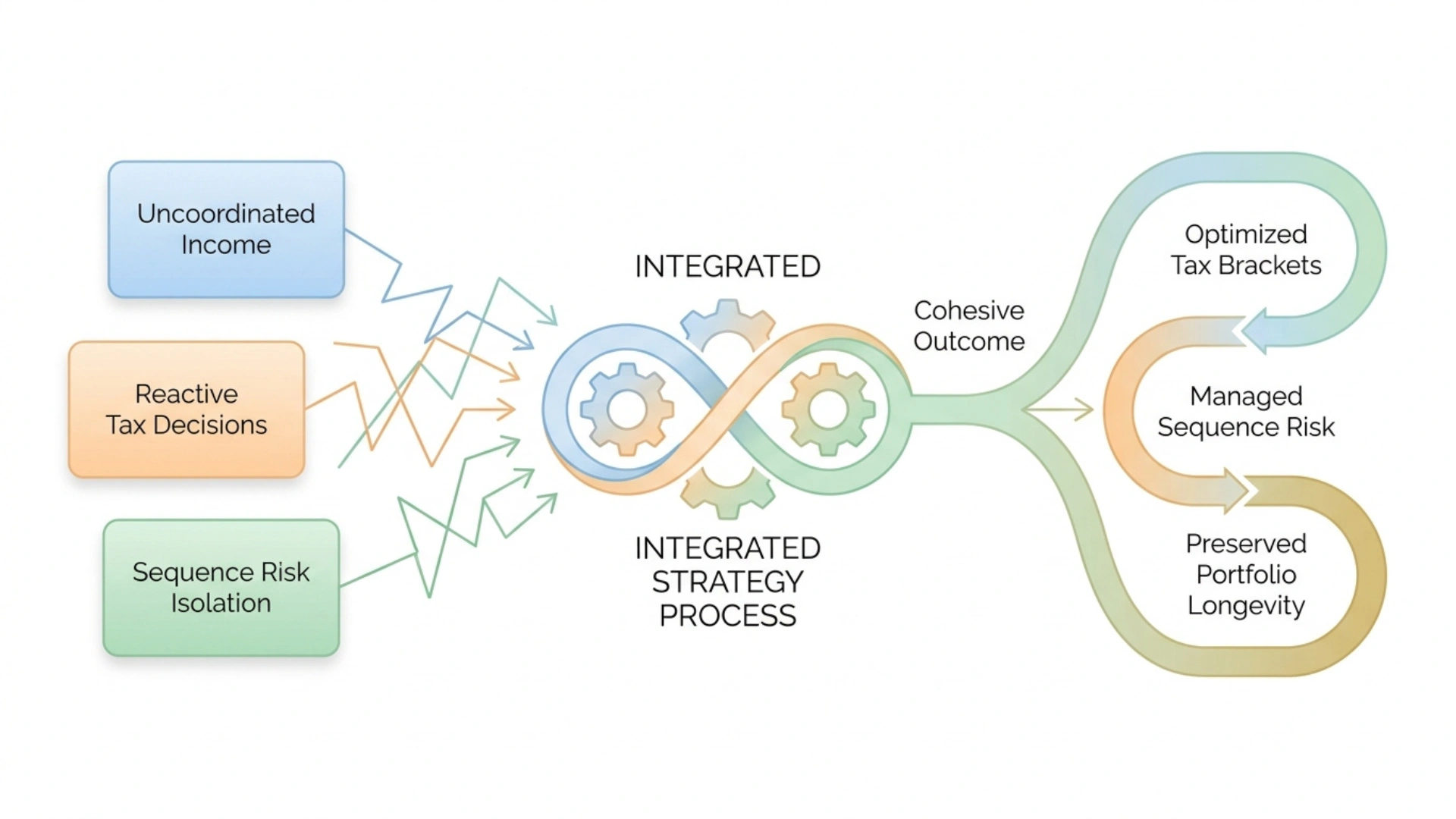
A well-designed income strategy doesn’t try to predict everything perfectly.
That’s not the goal.
The goal is something more practical:
Clarity and coordination.
It helps answer questions like:
● Where should income come from this year?
● How does that impact taxes next year?
● What does this mean for my future flexibility?
Instead of approaching withdrawals as isolated decisions, the plan becomes a connected system.
And when that happens:
● trade-offs become visible
● decisions become more intentional
● and the plan starts to feel more stable over time
Where This Fits Into the Bigger Picture
This is also where a lot of retirement plans begin to separate.
Because many people have:
● good investments
● strong savings
● reasonable assumptions
But they don’t have:
● a coordinated withdrawal strategy
● a tax-aware income plan
● or a system that connects everything together
That’s the difference between having pieces… and having a plan.
A Final Thought
Most people assume retirement income is something that happens naturally.
In reality, it’s something that needs to be designed.
Because once withdrawals begin:
● every decision has consequences
● every choice impacts future flexibility
● and every piece begins to interact
Where income comes from…
When it’s taken…
And how it fits into the rest of the plan…
All of it shapes the outcome over time.
And in many cases, the difference between a plan that feels smooth and one that feels uncertain isn’t how much money you have—
It’s whether those decisions are working together.
If you’ve never seen your income, taxes, and withdrawals viewed together, that’s typically where the biggest clarity comes from.