High net worth is often mistaken for financial immunity, yet some of the most significant wealth erosions occur within portfolios that appear successful on the surface. You may have a robust balance sheet, but if your tax strategy, investment management, and estate goals are functioning as isolated silos, you’re likely overlooking the subtle signs of a broken financial plan. True security isn’t found in the accumulation of assets alone; it resides in the seamless coordination of every moving part to ensure your legacy remains intact through shifting regulations and market cycles.
It’s natural to feel a sense of unease when your tax advisor and investment manager operate in different worlds, leaving you to bridge the gap between complex decisions. You deserve the certainty that comes from a fully integrated strategy, especially as the 2026 federal estate tax exemption settles at $15,000,000 and tax brackets remain permanent under recent legislation. By identifying these vulnerabilities early, you can transition from a fragmented approach to a unified framework. We’ll examine the seven red flags that indicate your strategy is at risk and show you how a holistic architect can bring your financial pillars into perfect harmony.
Key Takeaways
- Distinguish between a high-performing portfolio and a structurally sound strategy to ensure your wealth is protected from invisible gaps.
- Identify the seven specific signs of a broken financial plan that often go unnoticed until a major life event or tax law change occurs.
- Discover how the “One Plan. One Team. One Strategy.” framework replaces fragmented advice with a coordinated approach that aligns tax, investment, and estate goals.
- Learn why simple insurance policies are often insufficient for asset protection and how to evaluate your current structures for hidden vulnerabilities.
- Explore the “Fit” process as a diagnostic tool to audit your financial architecture and establish a secure, integrated foundation for your family’s legacy.
What Is a Broken Financial Plan for the Affluent?
For those with significant assets, a “broken” plan rarely manifests as an empty bank account or a lack of capital. Instead, it appears as a series of structural fractures that remain invisible during periods of market stability or personal health. True affluence can paradoxically act as a veil, masking the signs of a broken financial plan because the sheer volume of assets often compensates for inefficient tax strategies or outdated estate documents. A plan is truly broken when it lacks a cohesive architecture, leaving wealth vulnerable to avoidable erosion from legislative shifts, litigation, or uncoordinated advice.
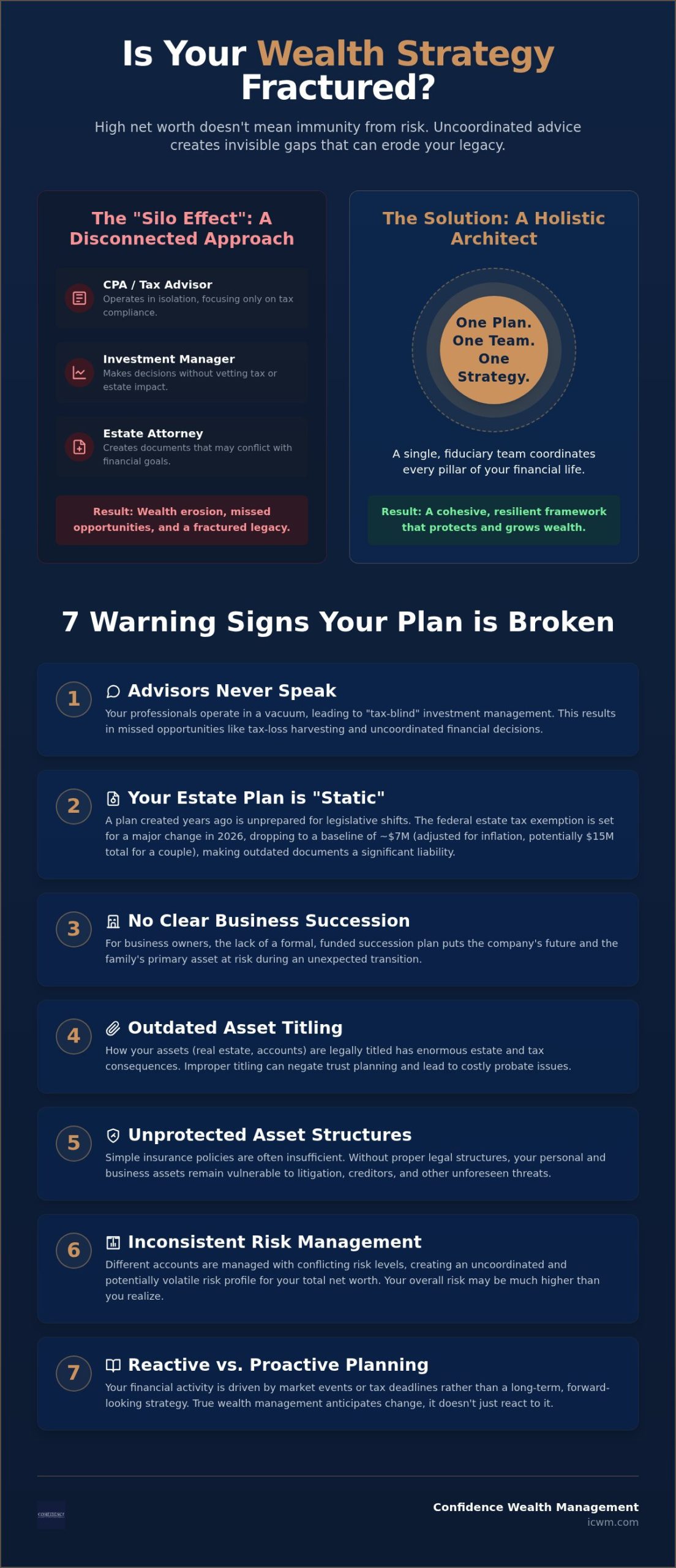
The primary driver of these failures is the “Silo Effect.” This occurs when your CPA, investment advisor, and estate attorney work in complete isolation from one another. While each professional may be competent in their specific niche, the lack of a central architect means that an investment move intended for growth might inadvertently trigger a massive, uncoordinated tax liability or contradict a directive in your legacy documents. Without a unified strategy, you aren’t managing a plan; you’re managing a collection of conflicting opinions.
The Difference Between a Portfolio and a Plan
Many families mistake a collection of high-performing investments for a comprehensive strategy. A portfolio focuses on asset allocation and market returns, but a plan evaluates how those assets interact with the broader context of your life and long-term legacy. A broken plan fails to account for the tax and estate impacts of every investment move, often leading to wealth leakage that quietly offsets market gains. A defective plan is one where critical financial decisions are made in isolation without considering the interconnectedness of all wealth pillars.
Why Traditional “Big Bank” Models Often Fail Affluent Families
Standardized models at large financial institutions are often built for volume rather than the meticulous coordination required for complex estates. These environments typically lack the fiduciary oversight needed to manage the nuances of asset protection or specialized business-exit planning. Fixing these fractures requires a boutique, fiduciary approach where a single team serves as a holistic architect. This ensures that every strategy is vetted for its impact on your total net worth and personal peace of mind. To begin identifying these gaps, you might consider the “Fit” process, which serves as a diagnostic audit of your current financial architecture.
The 7 Warning Signs Your Wealth Strategy Is Fractured
Identifying the signs of a broken financial plan requires looking past the growth of your portfolio and examining the structural integrity of your overall strategy. A fractured plan is often characterized by a lack of coordination between your financial pillars, creating vulnerabilities that only become visible during a crisis. These gaps typically include fragmented advisor communication, static estate documents, a lack of business succession planning, reactive tax compliance, outdated asset titling, unprotected asset structures, and inconsistent risk management across different accounts.
Many affluent families mistakenly believe that tax compliance is the same as tax strategy. If your primary interaction with tax planning is simply filing a return each April, you are likely missing proactive opportunities to minimize your lifetime tax burden. A truly integrated strategy evaluates the tax impact of every investment decision, ensuring that growth isn’t quietly eroded by avoidable liabilities or shifting federal regulations.
Sign 1: Your CPAs and Advisors Never Speak
When your financial professionals operate in a vacuum, you are essentially managing multiple fragmented plans. This “tax-blind” investment management often leads to missed opportunities for strategic moves like tax-loss harvesting or timely Roth conversions. Coordination ensures that investment decisions are vetted for their tax impact before the trade is made, which is a key component of our “One Plan. One Team. One Strategy.” philosophy. For deeper insight into this alignment, you can view our IRA planning webinar.
Sign 2: Your Estate Plan Is a “Static” Document
An estate plan created even five years ago may no longer serve its intended purpose. With the federal estate tax exemption currently at $15,000,000 per individual for 2026, many plans remain unprepared for future legislative shifts. If your asset titles aren’t perfectly aligned with your trust documents, or if your plan hasn’t been updated to reflect current laws, the foundation of your legacy is effectively broken. Our Legacy Planning 6 Steps webinar provides a framework for keeping these documents dynamic and coordinated.
Sign 3: You Lack a Formal Exit or Succession Strategy
For the business owner, the absence of a formal succession strategy is a critical red flag. A liquidity event without prior tax and wealth coordination can result in losing a significant portion of your hard-earned value to avoidable liabilities. Protecting your legacy requires evaluating beneficial business structures and exit strategies long before a sale is on the horizon. If you suspect your current strategy has these or other fractures, undergoing a comprehensive diagnostic audit can help identify and repair the gaps in your financial architecture.
The Silo Effect: Why Disconnected Advice Leads to Failure
Disconnected advice is the primary catalyst for the most common signs of a broken financial plan. When your professionals operate in isolation, you are forced to act as the primary coordinator, often translating complex tax data to your investment advisor or legal directives to your CPA. This friction doesn’t just create a mental burden; it creates structural risk. We believe the antidote to this fragmentation is the “One Plan. One Team. One Strategy.” philosophy. By serving as the central hub, we ensure that every decision is vetted from multiple angles before it is executed.
This integrated approach is more than a conceptual framework. It is a logistical commitment. Confidence Wealth Management coordinates tax return completion and estate document preparation through our network of affiliated firms to ensure that no detail is lost in transition. When your investment managers understand your full tax picture, they can make trades that are optimized for your specific 2026 tax bracket rather than just chasing generic returns. The emotional relief of having a single holistic architect overseeing these components allows you to focus on your personal life goals while we manage the technical complexities.
How Fragmentation Increases Risk
Fragmentation creates invisible gaps where wealth often leaks out. Asset protection vulnerabilities frequently occur in the space between “legal” and “financial” silos. For instance, an investment manager might recommend selling a long-term holding to capture a gain, unaware that the move will push you into the 20% capital gains threshold or trigger a Net Investment Income Tax. Without a coordinated strategy, a seemingly positive growth move becomes a tax-inefficient mistake. Fiduciary responsibility must extend across the entire wealth spectrum to ensure your assets are not only growing but are also shielded from litigation and unnecessary erosion.
The Role of the Fiduciary Boutique
A fiduciary boutique offers a distinct advantage by providing personalized, integrated oversight that larger institutions often struggle to replicate. We fix defective plans by closing the gaps between your various advisors and bringing every moving part into alignment. This proactive management style identifies vulnerabilities before they become crises, ensuring that your wealth strategy remains resilient through legislative changes and market shifts. You can see the difference this level of coordination makes by exploring our Integrated Investment Management services, where we unify your portfolio with your broader financial objectives.
Evaluating Hidden Vulnerabilities: Asset Protection and Risk Gaps
Many affluent individuals operate under the dangerous misconception that high-limit insurance policies alone constitute a complete defensive strategy. While insurance is a necessary tool, it’s merely one layer of a much broader structural architecture required to shield wealth from unforeseen threats. Identifying the signs of a broken financial plan often involves uncovering these hidden vulnerabilities where assets are held in personal names or within structures that offer little to no protection against professional liability or litigation. A truly secure plan ensures that asset protection is meticulously coordinated with your estate and tax strategies, creating a unified barrier that preserves your legacy.
Holding significant assets in vulnerable structures without a clear separation between personal and professional liability is a clear sign of a broken financial plan. When your wealth grows, the complexity of your risk profile increases proportionally, necessitating a shift from simple coverage to sophisticated structural design. This integration ensures that a legal challenge in one area of your life doesn’t trigger a catastrophic erosion of the wealth you’ve spent decades accumulating.
Protecting Wealth from Lawsuits and Creditors
There is a significant difference between the skill required to earn wealth and the strategy required to keep it. Many successful families neglect the evaluation of beneficial business structures, leaving their private holdings exposed to business-related creditors or professional lawsuits. By utilizing specialized entities and aligning them with your overall financial strategy, you can create a robust framework that discourages litigation before it begins. Effective asset protection must be established through proactive structural design, and for healthcare practitioners, Profiniti Services provides the specialized business strategy and tax solutions needed to integrate professional structures with a unified wealth plan.
Managing Volatility with a Coordinated Strategy
A strategy that lacks a defined protocol for market downturns is a hallmark of a fractured plan, as it leaves you vulnerable to emotional decision-making when stability is most required. We provide a framework for maintaining calm control through our Investment Strategies for Volatile Markets webinar, which explores how to navigate uncertainty with precision. Integrated tax planning also plays a vital role here, as strategic tax-loss harvesting can help mitigate the impact of market losses by creating offsets that lower your overall liability. This level of coordination ensures that even during periods of volatility, your plan continues to move toward its long-term objectives without unnecessary friction.
Fixing the Foundation: Transitioning to an Integrated Wealth Strategy
Recognizing the signs of a broken financial plan is the critical first step toward reclaiming control over your financial future. Repairing these fractures isn’t about purchasing new financial products; it’s about re-architecting the very foundation of your wealth. This transition requires moving from a reactive, piece-meal approach to a proactive, integrated framework where every moving part is brought into harmony. By consolidating professional oversight through a single fiduciary partner, you ensure that specialized expertise in tax, estate, and investment management is coordinated rather than siloed, allowing for a strategy that is as sophisticated as it is secure.
The ultimate objective of this transition is to provide you with the peace of mind that comes from knowing every pillar of your wealth is integrated. You shouldn’t have to carry the mental burden of coordinating between different advisors or worrying about hidden vulnerabilities. A unified strategy creates a narrative where professional services are directly linked to your personal well-being and the seamless transfer of your legacy. Through a meticulous and thorough vetting process, your financial architecture can be transformed from a collection of fragmented parts into a stable, protective, and long-term oriented plan.
While financial architecture protects your assets, the human side of your legacy often requires its own specialized care. For families navigating the interpersonal challenges that can accompany significant wealth, WJW Counselling & Mediation offers professional support and mediation services to help maintain personal well-being and family harmony.
Step 1: The Comprehensive Plan Audit
The repair process begins with a meticulous evaluation of your current financial architecture to identify the seven critical gaps that lead to plan failure. You must gather all relevant investment statements, recent tax filings, and estate documents to create a unified view of your net worth. This isn’t a surface-level review. It’s a deep dive into how these elements interact to identify where coordination is lacking. A plan-first methodology prioritizes the structural alignment of your assets before considering specific investment moves, ensuring your strategy is built on your personal objectives rather than generic market models.
Step 2: Aligning the Team
Once the audit is complete, the next phase involves synchronizing your professional advisors under a “One Team” philosophy. Confidence Wealth Management acts as the central hub, coordinating directly with affiliated tax and estate professionals to ensure every decision is vetted for its impact on your entire strategy. This alignment removes the burden of technical translation from your shoulders, allowing you to focus on your life goals with the certainty that your legacy is protected. Having a single team working toward a unified set of goals creates a level of efficiency and security that fragmented advice simply cannot match. We invite you to schedule a Fit meeting to begin this diagnostic audit and start the journey toward a truly unified wealth strategy.
Securing Your Legacy Through Strategic Integration
True financial security is not a passive state achieved by reaching a certain net worth; it’s a dynamic result of meticulous coordination and strategic oversight. By recognizing the signs of a broken financial plan, you’ve already taken the first step toward moving beyond the vulnerabilities of disconnected advice. A resilient strategy requires a holistic architect who can bring your tax planning, estate coordination, and investment management into a single, unified strategy.
Our boutique firm operates as an SEC-registered fiduciary, providing the personalized attention of a dedicated partner with the sophisticated resources required for national reach. We specialize in closing the gaps that standard models often overlook, ensuring that every pillar of your wealth is stable and aligned with your long-term goals. You deserve the freedom to focus on your life’s purpose while a team of experts meticulously manages the technical complexities of your legacy.
Take the opportunity to transform your financial architecture from a collection of fragmented parts into a protective, integrated whole. Your future deserves the certainty of a plan that leaves no stone unturned.
Frequently Asked Questions
How do I know if my financial plan is outdated?
A plan is outdated if it hasn’t been reviewed since major legislative shifts, such as the 2026 tax bracket updates, or if your personal goals have changed. A strategy that fails to account for the current $15,000,000 federal estate tax exemption is likely misaligned with your reality. Regular audits ensure your strategy remains dynamic and responsive to both market conditions and evolving legal requirements.
Can a financial plan be “broken” even if my investments are making money?
Yes, strong investment growth often masks the signs of a broken financial plan that lacks structural integrity. You might experience high returns while overlooking massive tax liabilities or asset protection vulnerabilities. A plan is truly healthy only when growth is paired with proactive tax strategy and estate coordination to ensure you actually keep what you earn through shifting economic cycles.
What are the 7 critical gaps in financial planning?
The seven critical gaps include fragmented advisor communication, reactive tax compliance, static estate documents, uncoordinated asset titling, lack of business succession planning, unprotected asset structures, and inconsistent risk management. These fractures create invisible vulnerabilities that lead to significant wealth erosion. Identifying these gaps is the primary goal of a holistic architectural audit of your current wealth strategy to ensure total coverage.
Why do I need tax and estate planning coordinated with my investments?
Coordination prevents investment decisions from triggering unintended tax liabilities or contradicting your legacy directives. For example, selling a position for growth without vetting it against your current tax bracket can lead to an avoidable capital gains hit. Alignment ensures that every financial move is reviewed by a unified team to protect your assets and streamline the eventual transfer of your estate.
What is the risk of having a “siloed” financial plan?
The primary risk is wealth leakage caused by conflicting advice from isolated professionals. When your CPA and investment advisor don’t communicate, you lose opportunities for strategic tax-loss harvesting and timely Roth conversions. This fragmentation places the mental burden of coordination on you, increasing the likelihood that critical vulnerabilities in asset protection or estate titling will remain unaddressed until a crisis occurs.
How does a fiduciary boutique differ from a traditional wealth manager?
A fiduciary boutique provides personalized, integrated oversight that goes beyond the standardized models found at large institutions. Unlike commission-based environments, a boutique firm acts as a holistic architect, coordinating tax and estate strategies under one roof. This approach ensures a higher level of accountability and a personalized strategy that is meticulously tailored to your family’s unique legacy and personal well-being.
What happens during a financial plan audit or “Fit” meeting?
During a Fit meeting, we conduct a diagnostic audit of your current financial architecture to identify structural fractures. We gather your investment, tax, and estate data to create a unified view of your net worth. This process allows us to pinpoint invisible gaps and determine if our “One Plan. One Team. One Strategy.” framework is the right solution for your specific needs.
Is it difficult to switch to an integrated wealth management firm?
The transition is a methodical process designed to alleviate your mental burden rather than add to it. A dedicated partner manages the administrative complexities of consolidating your oversight and aligning your various advisors. While the initial audit requires gathering specific documentation, the result is a simplified, unified strategy that provides long-term security and the freedom to focus on your personal life goals.
Disclaimer
Confidence Wealth Management Inc (CWM) is an SEC registered investment adviser. Confidence Wealth & Insurance Solutions Inc (CWIS) is licensed under the NV Department of Insurance, license no. 3647322. CWM and CWIS are two separate affiliated companies, and have no affiliation with government, state, or local agencies. Investment advisory services are provided by CWM. All insurance products and services provided by CWIS. Information presented is for educational purposes only and does not intend to make an offer or solicitation for the sale or purchase of any specific securities, investments, or investment strategies, and may not be relied on for the purpose of avoiding any federal tax penalties or obligations. All content is derived from sources believed to be accurate at time of publication. Investments involve risk and, unless otherwise stated, are not guaranteed. Past performance is not indicative of future performance. Consult with a qualified financial adviser and/or tax professional before implementing any strategy discussed herein.