Nearly half of high-net-worth individuals in the United States believe their wealth strategies require significant improvement, often sensing that their professional team isn’t speaking the same language. You might feel a lingering anxiety that your CPA and financial advisor are operating in separate silos; this leaves you to bridge the gap between complex tax mandates and investment goals yourself. It’s a heavy mental burden to carry, especially when you suspect that an outdated estate plan or hidden liability could jeopardize the legacy you’ve worked so hard to build. Fixing defective financial plans isn’t just about adjusting the numbers. It’s about restoring the architectural integrity of your entire financial life through deliberate coordination.
In this guide, we’ll show you how to identify the structural vulnerabilities that lead to plan failure and unnecessary tax exposure. You’ll discover a systematic approach to unifying your tax, estate, and investment management into one cohesive strategy that removes the administrative weight from your shoulders. By following this integration checklist, you can move from a fragmented collection of accounts to a synchronized plan that offers genuine security and the freedom to focus on your personal goals. We’ll explore the essential pillars of coordination that ensure no detail is overlooked and every asset is protected within a stable, long-term framework.
Key Takeaways
- Recognize that a wealth strategy is fundamentally defective when tax, estate, and investment components are fragmented, even if individual portfolios appear to be performing well.
- Master the three-step process of auditing, aligning, and integrating your assets, which is essential for fixing defective financial plans and securing your long-term legacy.
- Identify hidden vulnerabilities in your current strategy by evaluating the level of active coordination between your primary financial professionals.
- Move beyond reactive tax filing toward a proactive coordination model that projects the tax implications of every trade before they occur.
- Establish a unified risk profile that harmonizes your investment management with your asset protection strategy to ensure total coverage in a litigious environment.
Beyond the Math: What Defines a ‘Defective’ Financial Plan?
A financial plan is often mistaken for a simple investment portfolio, yet for the high-net-worth family, the two concepts are vastly different. While a portfolio tracks the performance of assets, a defective plan is characterized by a fragmented strategy where tax, estate, and investment components work in isolation or, worse, direct conflict. You might have an investment manager who achieves impressive annual returns, but if those gains trigger an uncoordinated tax liability that erodes your net wealth, the plan has failed its primary objective. While many understand the basic concept of What is a Financial Plan?, high-net-worth individuals often find that a standard definition doesn’t account for the intricate layers of coordination required at their level of complexity. This lack of architectural harmony is the hallmark of a defective strategy.
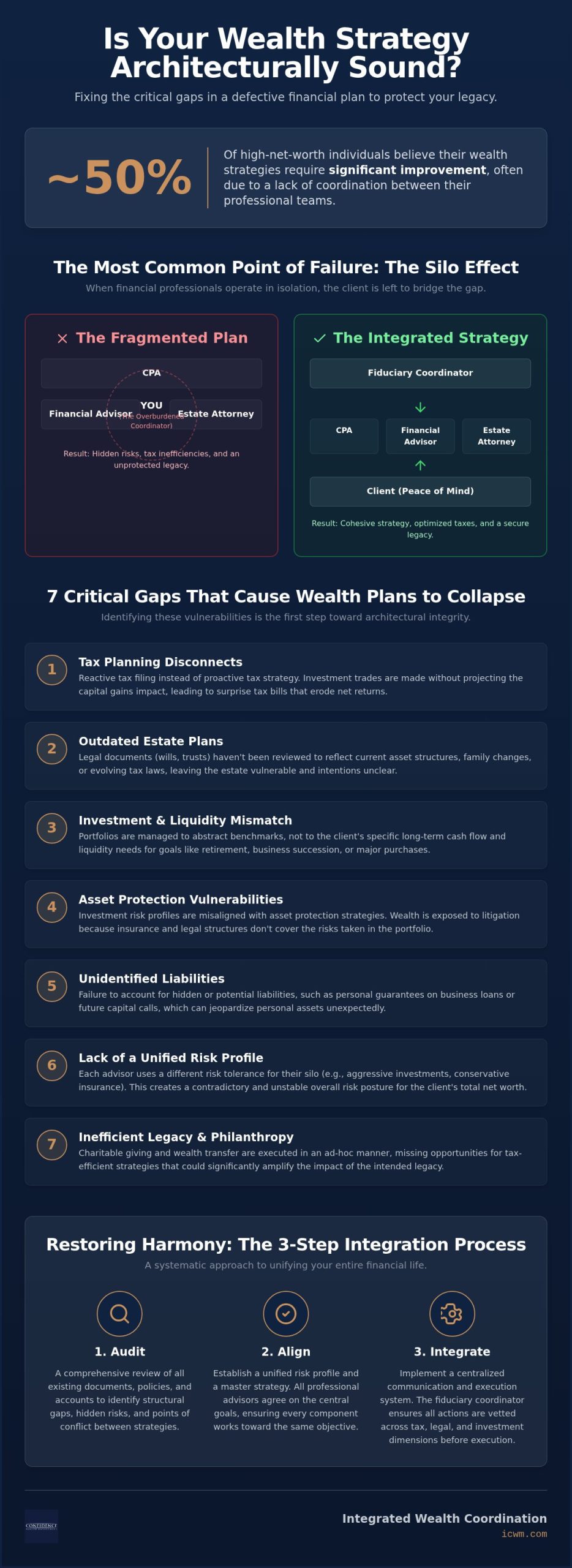
The Silo Effect remains the most common cause of these structural gaps; it occurs when your CPA, estate attorney, and financial advisor operate as independent entities without a centralized communication channel. This disconnect forces you to act as the primary coordinator, a role that often leads to overlooked vulnerabilities. Fixing defective financial plans requires moving past the math of individual accounts to address the interconnectedness of your entire estate. When these professionals don’t collaborate, the ultimate cost manifests as unnecessary tax burdens, increased legal exposure, and the slow erosion of the legacy you intend to leave behind.
Symptoms of a Fragmented Wealth Strategy
Recognizing the signs of a defective plan early can prevent significant long-term loss. These symptoms often appear as subtle administrative burdens before they escalate into financial setbacks:
- Receiving surprise tax bills at year-end despite a supposedly conservative or passive investment approach.
- Holding estate documents that haven’t been reviewed or updated to reflect current asset structures or changes in tax law.
- Discovering that your investment risk profile is completely detached from your asset protection goals, leaving your wealth vulnerable in a litigious environment.
The Fiduciary Standard in Plan Repair
Repairing these structural defects requires more than a new investment product; it demands a fiduciary approach centered on architectural integration. A fiduciary has a legal and ethical duty to identify and close planning gaps that could compromise a client’s financial security. When fixing defective financial plans, the professional’s primary role is to act as a protective guardian who evaluates how a decision in one area, like an investment trade, will ripple through your tax and estate structures. This process involves shifting from a product-selling mindset to one of comprehensive coordination. By acting as a holistic architect, a fiduciary ensures that every trade, legal document, and tax strategy is vetted against the others to create a stable, unified wealth strategy that provides lasting peace of mind.
The 7 Critical Gaps That Cause Private Wealth Plans to Collapse
A sophisticated wealth strategy is a living architecture. It requires constant oversight to ensure that growth in one area doesn’t create a hidden vulnerability in another. Most private wealth plans collapse not because of poor market performance, but because of critical structural gaps that go unnoticed during periods of stability. Fixing defective financial plans involves a meticulous evaluation of how these different financial pillars interact. When these components aren’t aligned, the resulting friction creates unnecessary risk for your family legacy.
Identifying these gaps is the first step toward restoring the integrity of your strategy. Consider these common points of failure:
- Investment Management Gaps: Portfolios often lack alignment with long-term liquidity needs, focusing on abstract benchmarks rather than the specific timing of your cash flow requirements.
- Tax Planning Disconnects: A major defect occurs when advisors fail to project tax impacts before trades are made, leading to preventable capital gains liabilities.
- Estate Planning Misalignment: There is frequently a missing link between asset titles and trust documents; if an account isn’t titled correctly, the most sophisticated trust remains an empty shell.
- Asset Protection Vulnerabilities: Without proper structuring, high-net-worth families remain exposed to lawsuits and creditors, risking assets that should be legally shielded.
A thorough evaluation of your current wealth structures can reveal these vulnerabilities before they become costly failures, allowing you to move forward with a sense of calm control.
The Coordination Gap: Tax and Estate Alignment
Wealth plans often become brittle because tax returns and estate strategies are treated as separate workstreams. Your tax profile changes every year, yet many estate documents remain stale, failing to reflect current regulatory environments or shift in asset values. Fixing defective financial plans requires an annual coordination meeting where your tax and estate professionals synchronize their data. Utilizing affiliated planning firms can bridge this gap, ensuring that your legal documents and tax strategies are always in harmony.
Business Exit and Transition Vulnerabilities
A business exit is often the most significant financial event of a lifetime, yet it’s frequently where plans fail most spectacularly. Defects in business-exit financial planning occur when owners don’t evaluate beneficial business structures early enough to optimize for wealth preservation. Without proactive tax coordination, a major liquidity event can trigger massive, preventable tax spikes. Ensuring your business transition is integrated into your broader wealth plan protects your hard-earned equity from unnecessary erosion during the handoff.
The Financial Plan Audit Checklist: Identifying Hidden Vulnerabilities
A resilient wealth strategy is never a “set it and forget it” endeavor; rather, it requires a systematic vetting process to ensure that your various professional silos haven’t drifted apart. Fixing defective financial plans starts with a rigorous audit of the communication channels between your primary advisors. Ask yourself: do your financial advisor, CPA, and estate attorney meet together at least once per year to synchronize their efforts? If they don’t, even the most sophisticated strategies can succumb to internal contradictions that jeopardize your long-term security.
Your audit should also evaluate the interconnectedness of your risk management and asset protection strategies. It’s common to find investment risk profiles that are completely detached from legal structures, leaving your family vulnerable to external threats. Additionally, given that the federal estate and gift tax exemption stands at $15 million per individual and $30 million for married couples as of 2026, your estate documents must be reviewed to ensure they remain optimized for these specific thresholds. Finally, verify that a proactive plan exists to mitigate the tax impact of required minimum distributions (RMDs), as uncoordinated withdrawals can inadvertently push you into a higher tax bracket and erode your liquid wealth.
Structural Integrity Assessment
The technical foundation of your plan relies on the precise alignment of your asset titles with your trust requirements. A common defect is the “empty trust” syndrome, where assets remain titled in personal names rather than being correctly assigned to the trust entity. Your audit must include a thorough beneficiary review to ensure designations are current across all accounts, alongside a risk management check that confirms your insurance coverage is fully coordinated with your overarching wealth plan. This meticulous attention to detail ensures that every technical action serves your broader life goals.
Tax Efficiency Verification
True wealth preservation requires moving beyond simple tax preparation toward comprehensive tax coordination. This involves verifying that your portfolio utilizes tax-loss harvesting and asset location optimization to minimize the drag on your returns. By evaluating how your annual tax return completion aligns with your wealth growth goals, you can identify opportunities for structural improvement. Proactive tax planning coordination serves as a protective barrier that prevents wealth leakage, ensuring that more of your capital remains working for your family legacy rather than being lost to preventable liabilities.
Bridging the Silos: Strategies for Integrated Wealth Coordination
The journey of fixing defective financial plans requires a fundamental shift in how you perceive your professional advisory team. Most high-net-worth families inadvertently operate as the central switchboard, manually relaying information between a CPA who looks at the past and an investment advisor who looks at the future. This “telephone game” is more than just an administrative nuisance; it is a structural vulnerability that leads to conflicting advice and missed opportunities. By adopting the Holistic Architect model, you centralize the coordination of every planning component, ensuring that your tax strategies, estate documents, and investment portfolios are designed to support a single, overarching vision.
True coordination moves you from reactive tax preparation, where you simply record what has already happened, to proactive tax coordination. In this advanced model, every significant financial decision is vetted for its tax impact before it is executed. For instance, with the 2026 federal income tax rates ranging from 10% to 37%, a coordinated plan ensures that income is recognized in the most efficient manner possible. This level of foresight reduces the mental burden of management, replacing constant decision fatigue with a sense of calm control. You are no longer managing a collection of separate parts; you are overseeing a unified engine designed for wealth preservation.
To see how this level of integration can transform your strategy, you can request a consultation for an integrated wealth strategy to begin the process of structural alignment.
The Power of Unified Strategy
An integrated wealth strategy creates more predictable outcomes by eliminating the friction between competing financial goals. When your wealth management, tax planning, and estate coordination are handled under one roof, the strategy becomes more resilient against market volatility and regulatory changes. This unified approach is particularly vital for legacy protection, as it ensures that the transfer of assets to the next generation is not hindered by uncoordinated legal structures or preventable tax spikes. It provides the stability required to focus on your life goals rather than technical administrative burdens.
Coordinating with Affiliated Firms
The execution of a complex wealth plan often requires specialized expertise in areas such as estate document preparation or specialized tax return completion. By working with a primary planner who maintains direct coordination with affiliated firms, you ensure that your strategy is executed exactly as designed. This prevents “lost in translation” errors that frequently occur when independent specialists interpret a plan without context. Fixing defective financial plans through this collaborative framework ensures that every legal entity and tax filing remains in perfect harmony with your long-term investment objectives, leaving no stone unturned in the quest for total coverage.
Restoring Harmony: Transitioning to an Integrated Wealth Strategy
The process of fixing defective financial plans is a deliberate journey that moves your wealth from a state of fragmentation to one of total harmony. This transition is achieved through three distinct phases: Audit, Align, and Integrate. It begins with a deep forensic review of every existing account, legal document, and tax return to locate the friction points that cause plan failure. Once these gaps are visible, the alignment phase brings your investment risk, tax liabilities, and estate protections into a single strategic orbit. Integration is the final, ongoing step where your professional team operates as a single unit, providing the protective oversight needed to prevent future defects from taking root.
Transitioning to this unified model alleviates the mental burden of managing disparate advisors and conflicting advice. When your wealth strategy is architecturally sound, you gain the freedom to focus on your personal life and legacy goals rather than technical administrative hurdles. You can stop acting as the middleman between your CPA and advisor, trusting that every moving part of your financial life is being meticulously managed. This shift provides a sense of calm control, replacing anxiety over hidden liabilities with the security of a well-vetted strategy.
The Boutique Advantage for Complex Needs
Taking the First Step Toward Integration
Preparing for a plan audit with a fiduciary firm is a proactive step toward securing your family’s future. It involves gathering your current estate documents, recent tax returns, and investment statements for a comprehensive evaluation. Fixing defective financial plans requires identifying these vulnerabilities before they escalate into structural failures, which is the most effective way to preserve your hard-earned capital. By taking this first step, you ensure that your strategy is built on a foundation of total coordination and long-term stability. To begin this process, you can Schedule a comprehensive gap analysis with Confidence Wealth Management to ensure your strategy is restored to full harmony.
Securing Your Legacy Through Strategic Integration
A resilient wealth strategy requires more than just high-performing assets; it demands the meticulous alignment of tax, estate, and investment management. By recognizing the structural gaps that lead to plan failure, you can move away from the administrative burden of managing uncoordinated professionals. Fixing defective financial plans is a process of restoring order and ensuring that every technical decision serves your broader life vision. This transition allows you to replace the anxiety of hidden liabilities with a sense of calm, protective oversight.
At Confidence Wealth Management, our fiduciary boutique approach specializes in the complex needs of high-net-worth families. We provide integrated tax and estate coordination under one roof, acting as a dedicated partner in your wealth preservation journey. You deserve the freedom to focus on your family and personal goals, knowing that your strategy is being managed by seasoned experts who leave no stone unturned. Secure your legacy with a comprehensive plan audit at Confidence Wealth Management and take the first step toward a synchronized future. Your hard-earned wealth is a foundation for your legacy; it’s time your financial plan reflected that stability.
Frequently Asked Questions
What are the most common signs that my financial plan is defective?
The most common signs include receiving unexpected tax liabilities despite conservative investment choices and feeling as though your various advisors are providing conflicting guidance. You might also notice that your estate documents no longer reflect your current asset structure or that your investment risk doesn’t align with your asset protection goals. Fixing defective financial plans often begins by recognizing these subtle administrative burdens before they evolve into significant financial losses or legal vulnerabilities.
How often should a high-net-worth financial plan be audited for gaps?
A comprehensive audit should occur at least once per year to ensure your strategy remains synchronized with evolving tax laws and your personal life goals. Major life events, such as a business exit or a significant change in federal tax exemptions, like the $15 million individual threshold in 2026, also necessitate an immediate review. Regular vetting prevents structural drift and ensures that your professional team remains in total harmony across all planning pillars.
Why is tax planning coordination different from just doing my taxes?
Tax planning coordination is a proactive strategy that projects the tax impact of every financial decision before it occurs, whereas tax preparation is a reactive reporting of past events. By coordinating your trades and distributions with your tax profile, you can utilize techniques like asset location and tax-loss harvesting to minimize wealth leakage. This forward-looking approach ensures that your portfolio growth remains as tax-efficient as possible throughout the entire year.
Can a defective estate plan be fixed without starting from scratch?
Yes, most defective estate plans can be repaired through targeted amendments and the correct titling of assets without needing a complete rewrite. The primary focus is often aligning your current holdings with your existing trust requirements and updating beneficiary designations to reflect your current wishes. Meticulous vetting of these documents ensures they remain resilient against changes in the regulatory environment, providing you with a sense of calm control over your legacy.
What does a fiduciary wealth management firm do differently when fixing plans?
A fiduciary firm operates under a legal and ethical obligation to prioritize your best interests, focusing on structural integration rather than the sale of specific financial products. When fixing defective financial plans, a fiduciary acts as a holistic architect, evaluating how various components like tax and estate planning interact with your investments. This comprehensive oversight identifies vulnerabilities that traditional product-focused advisors often miss, ensuring your entire wealth ecosystem is stable and protective.
How does asset protection integrate with my overall investment strategy?
Asset protection integrates with your strategy by ensuring your legal structures, such as trusts or entities, are harmonized with your investment risk profile. This coordination shields your liquid wealth and business interests from potential litigation or creditor claims that could otherwise jeopardize your family’s security. By vetting these protections alongside your portfolio, you create a unified defense that secures your capital while allowing you the freedom to focus on your long-term life goals.
What is the ‘silo effect’ in financial planning and why is it dangerous?
The silo effect occurs when your CPA, attorney, and financial advisor work independently without a centralized communication channel, leading to fragmented and often contradictory advice. This lack of coordination is dangerous because it creates hidden gaps where tax inefficiencies and legal vulnerabilities can thrive unnoticed. Eliminating these silos through integrated coordination ensures that every professional is working toward a single, unified vision for your financial well-being and legacy preservation.
Is it possible to coordinate my existing CPA with a new wealth management firm?
It’s absolutely possible to maintain your relationship with your current CPA while transitioning to an integrated wealth management model. A boutique fiduciary firm acts as the central coordinator, bridging the gap between your tax professional and your investment strategy to ensure total alignment. This collaborative framework removes the administrative weight from your shoulders, allowing your existing experts to work in harmony under a single, overarching strategy that leaves no stone unturned.
Disclaimer
Confidence Wealth Management Inc (CWM) is an SEC registered investment adviser. Confidence Wealth & Insurance Solutions Inc (CWIS) is licensed under the NV Department of Insurance, license no. 3647322. CWM and CWIS are two separate affiliated companies, and have no affiliation with government, state, or local agencies. Investment advisory services are provided by CWM. All insurance products and services provided by CWIS. Information presented is for educational purposes only and does not intend to make an offer or solicitation for the sale or purchase of any specific securities, investments, or investment strategies, and may not be relied on for the purpose of avoiding any federal tax penalties or obligations. All content is derived from sources believed to be accurate at time of publication. Investments involve risk and, unless otherwise stated, are not guaranteed. Past performance is not indicative of future performance. Consult with a qualified financial adviser and/or tax professional before implementing any strategy discussed herein.