

Most people think retirement planning is about how much they’ve saved.
In reality, it’s a handful of key decisions that either simplify everything or quietly make the plan harder to manage over time.
And while the amount matters, the outcome of retirement is often shaped less by what you’ve saved and more by the decisions made right before it begins.
These decisions don’t always feel urgent.
They’re often pushed off with thoughts like:
“We’ll figure that out later”
“We’ll deal with it when we get there”
But over time, these are the decisions that end up defining how income actually flows, how taxes show up year to year, and how much flexibility you really have when things don’t go exactly as expected.
Retirement Doesn’t Come Down to One Decision
As you get closer to retirement, something important changes.
Financial decisions stop being isolated. They start interacting.
What used to feel separate — investments, taxes, income — now move together.
And that’s why these decisions matter more than most people expect. Because they don’t just affect one year. They shape everything that comes after.
Where Your Income Comes From

One of the biggest decisions isn’t just how much you take out. It’s where that income actually comes from.
Different sources behave very differently. IRAs and 401(k)s, brokerage accounts, Roth accounts, and Social Security or pensions each carry their own tax treatment, timing implications, and impact on future years.
The order you use them can make a meaningful difference in how much you pay in taxes, how long your portfolio lasts, and how much flexibility you have later.
This is often where people first realize income decisions don’t stand alone. The source, the timing, and the structure all interact.
When You Turn On Income
Timing is the next layer.
Decisions like when to start Social Security, when to begin withdrawals, and how to bridge the early retirement years all carry long-term consequences.
And these decisions don’t just affect income. They affect tax brackets, healthcare costs, and how future income stacks up.
The Tax Side (Where It Often Sneaks Up)
This is one of the biggest areas where I see plans drift.
In the early years of retirement, taxes can feel relatively low. Income may be lighter, withdrawals may be controlled, and everything feels manageable.
But over time, things change. Required minimum distributions begin, income sources start stacking, and taxable income rises — sometimes quickly.
That’s when people start to see larger tax bills than expected, less control over where income comes from, and fewer options than they thought they’d have.
The part that’s frustrating is this: it often didn’t have to happen that way. Different decisions earlier — around timing, sequencing, and tax strategy — could have created more control later.
How Conservative (or Not) to Be
This is another decision that feels simple but isn’t.
Many people naturally shift toward being more conservative as retirement approaches. That instinct makes sense.
But being too conservative can limit growth, increase reliance on withdrawals, and create pressure over time. On the other hand, taking on too much risk creates its own issues.
The real decision isn’t aggressive vs. conservative. It’s whether your allocation actually supports how the plan is going to function.
How Flexible the Plan Is
This is the one that doesn’t get talked about enough.
Some plans become very rigid — income is fixed, decisions are locked in, and flexibility is limited. Others allow for adjustments over time, better responses to market conditions, and more control in different years.
That flexibility often becomes the difference between reacting and deciding.
What Happens When These Decisions Aren’t Coordinated
Individually, each of these decisions can be reasonable. But when they aren’t connected, the experience of retirement starts to feel different.
This is where people begin to notice higher taxes than expected, uncertainty around withdrawals, being more conservative than necessary, or shifting decisions based on market noise.
This is often where people realize the decisions they’ve made were each reasonable — but they weren’t designed as one plan.
Nothing is broken. But the plan starts to feel harder to navigate.
What Changes When They Are Coordinated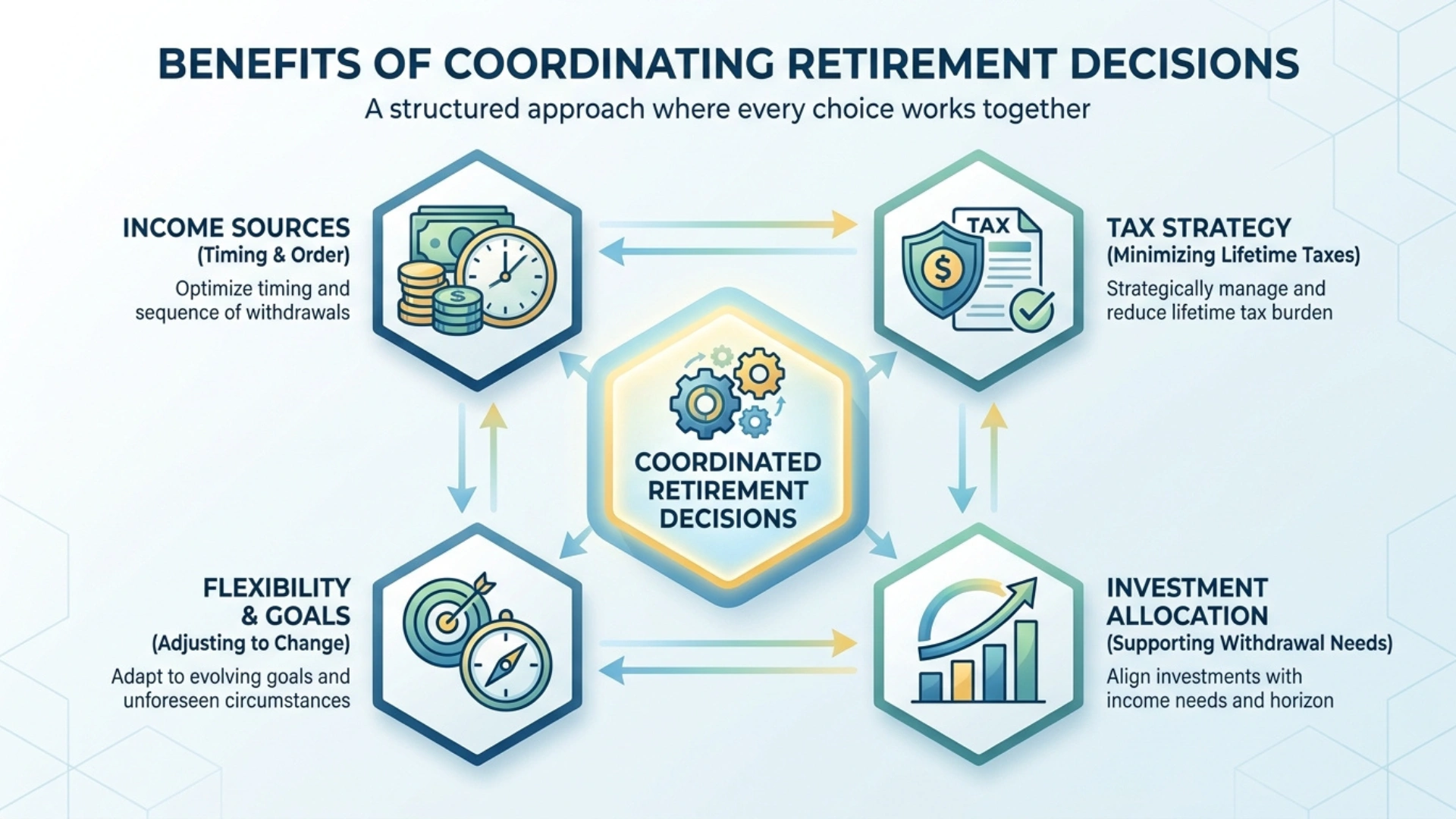
When these decisions are viewed together, something shifts.
Not because everything becomes perfect, but because it starts to make sense. Income decisions align with tax strategy. Tax decisions consider future years. Investment positioning supports withdrawals. And tradeoffs become clearer.
Instead of asking “What should I do this year?”, the question becomes “How does this decision fit into everything else?”
And that changes how the plan feels: more structured, more intentional, easier to move forward with.
A Final Thought
Retirement doesn’t hinge on one big decision. It’s shaped by a handful of decisions made right before it begins and how well those decisions work together over time.
Because in the end, it’s not just about what you’ve built. It’s about how you use it, how those choices interact, and how clearly you understand what comes next.
When those pieces aren’t designed together, the plan works harder than it needs to. When they are, the structure carries the weight — and the decisions that follow become easier to make.