
With all the attention around the SpaceX IPO, it feels like a rare opportunity.
A company that’s changed an entire industry…
A massive valuation…
And for the first time, everyday investors can participate.
It creates a sense of:
“I don’t want to miss this.”
And that reaction is completely natural.
But there’s an important piece of the story that often gets overlooked:
The word “early” doesn’t mean what most people think it does.
Why IPOs Generate So Much Excitement

IPOs have always carried a certain level of energy around them.
There’s:
● media attention
● limited availability of shares
● and a compelling narrative about future growth
In many cases, stocks also “pop” on the first day—sometimes significantly—reinforcing the idea that there’s quick upside available.
That combination creates urgency.
It feels like a moment you’re supposed to act on.
What “Going Public” Actually Means Today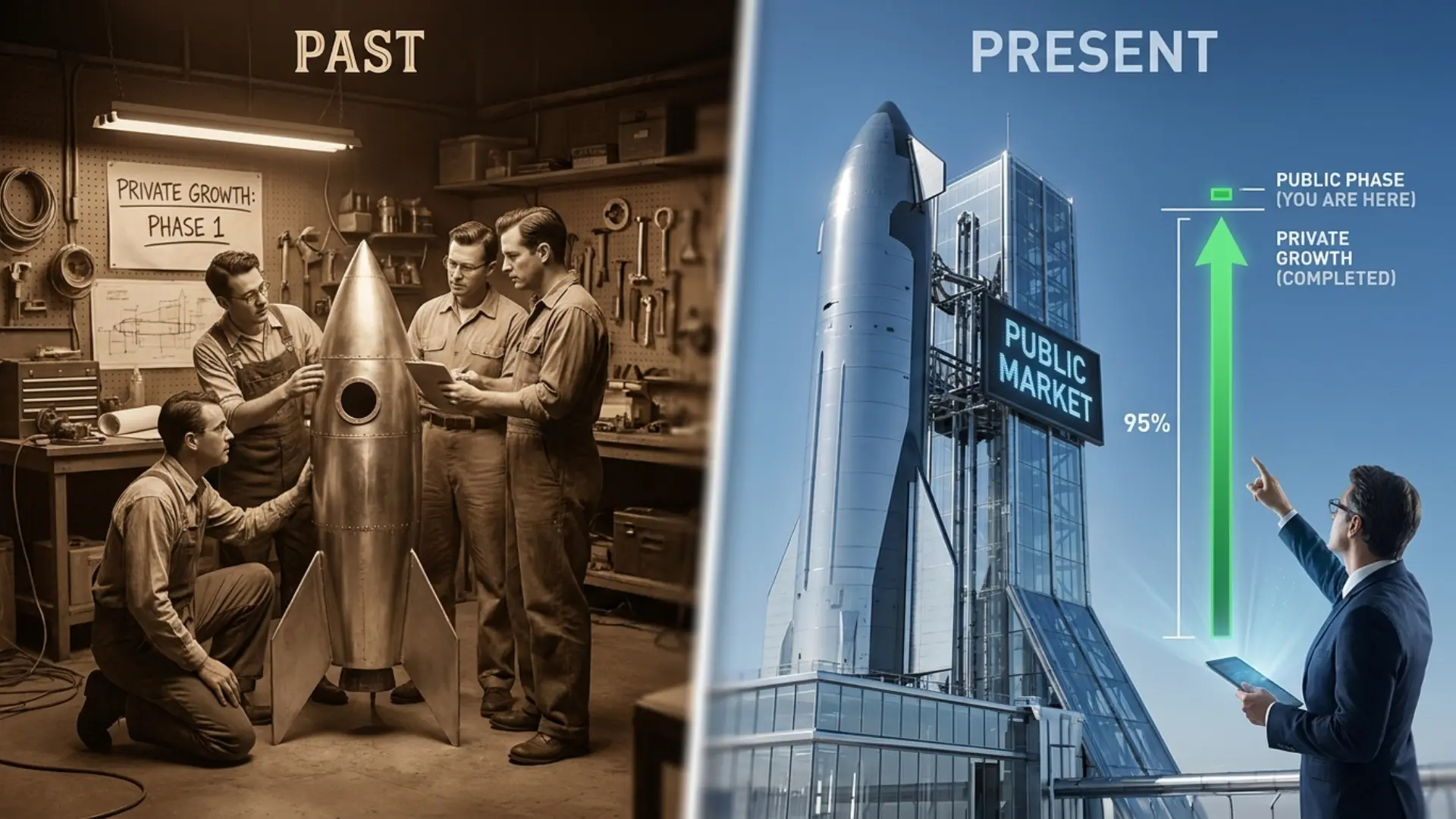
Years ago, companies often went public earlier in their growth cycle.
Investors could participate in more of the company’s expansion.
Today, that’s changed.
Many companies—especially ones like SpaceX—stay private for much longer.
They raise capital privately, grow rapidly, and reach substantial valuations before becoming publicly available.
Which means:
By the time a company goes public, a large portion of its growth may already be reflected in the price.
For public investors, the IPO often represents:
● a transition point
● not the starting point
What Happens After the IPO
The IPO itself gets the headlines.
But what happens after is where things actually matter.
The typical pattern tends to look something like this:
● Day 1 → attention and volatility
● First few weeks → price discovery
● First year → expectations vs. reality
And this is where things start to shift.
Some IPOs do well.
But many experience a different outcome.
Research has shown that IPOs often:
● underperform broader markets in their first year
● and can give back early gains over time
In fact, larger IPOs frequently see significant drawdowns at some point in their first year—even when the long-term story remains intact
The Risks Most People Don’t Think About
This is where the conversation becomes more practical.
Valuation risk
IPO pricing is based heavily on future expectations.
Not just what the company is today—but what it could become.
That leaves less room for error.
Sequence of returns risk
If someone invests heavily into a volatile IPO and it declines early, the timing matters.
Losses early on—especially alongside withdrawals or portfolio changes—can have a larger impact than expected.
Lock-up periods
Early investors, employees, and insiders typically cannot sell their shares right away.
These lock-up periods often last 90–180 days.
When they expire:
● more shares can enter the market
● increasing supply
● and sometimes putting downward pressure on price
Insider dynamics
IPOs also provide liquidity for early stakeholders.
That doesn’t mean the company isn’t strong.
But it does mean:
The interests of early investors and new investors aren’t always aligned in the short term.
Dilution risk
Companies may issue additional shares in the future to fund growth or acquisitions.
This can reduce existing ownership over time.
For investors, that’s something that often isn’t front of mind.
Where This Becomes a Bigger Decision
None of this means IPOs should be avoided.
SpaceX may go on to be an incredibly successful public company over the long term.
That’s not really the point.
The point is understanding how these opportunities fit into a broader plan.
Because what tends to happen is this:
● a compelling story leads to a concentrated decision
● that decision introduces volatility
● and that volatility shows up at the wrong time
👉 This is often where people realize the decision made sense on its own—but not fully as part of their overall strategy.
A Better Way to Approach It
Instead of asking:
“Should I invest in this IPO?”
A more useful question is:
● How does this fit into my overall allocation?
● What role is this investment supposed to play?
● What happens if it declines early?
● Do I have flexibility if the timing doesn’t work?
Those questions don’t eliminate uncertainty.
But they put the decision in context.
A Final Thought
Opportunities like this are always going to attract attention.
And in many cases, they should.
But the biggest risk isn’t missing out on something new.
It’s making a decision that doesn’t align with everything else you’ve already built.
Because in the end, it’s not just about finding the next opportunity—
It’s about making sure every decision works together.