This is a surprisingly common retirement experience.
Someone looks at their tax return or Medicare notice and says:
“Nothing really changed… but my taxes went up.”
More often than not, that’s true — at least from their point of view.
They didn’t sell anything major.
They didn’t increase spending.
They didn’t change lifestyle.
And yet, the numbers shifted.
The Illusion of Doing Nothing

Retirement income often arrives quietly.
Interest is credited.
Required distributions occur automatically.
The taxation of Social Security adjusts in the background.
Nothing feels like a decision — yet taxable income builds.
From the outside, it can feel random.
From a planning perspective, it’s usually predictable.
Why Cash and “Safe” Money Isn’t Neutral
Cash feels inactive.
From a tax standpoint, it isn’t.
Interest income is taxed as ordinary income. It stacks on top of Social Security, required distributions, and portfolio withdrawals.
When interest rates rise, many retirees discover this the hard way.
They didn’t take investment risk.
They didn’t chase returns.
They simply held more cash — and the system responded around it.
What feels like safety can quietly increase tax exposure.
How Small Changes Create Bigger Effects
A relatively modest increase in interest income can:
● Push taxable income into a higher bracket
● Increase how much Social Security is taxed
● Trigger Medicare premium adjustments
None of this is obvious when viewing accounts individually.
It only becomes clear when everything converges — often after the year has already ended.
That’s why the surprise feels frustrating. Cause and effect aren’t visible when decisions are made in isolation.
This Usually Isn’t a Cash Problem
Most of the time, when taxes rise unexpectedly in retirement, it isn’t because someone made a poor decision.
It’s because different pieces of the plan evolved independently — and no one was actively reconnecting them as circumstances changed.
Cash is a good example.
Held in isolation, it feels simple and safe.
Viewed inside the full retirement picture, it affects taxes, income timing, Medicare premiums, portfolio withdrawals, and long‑term flexibility.
Where Integration Actually Matters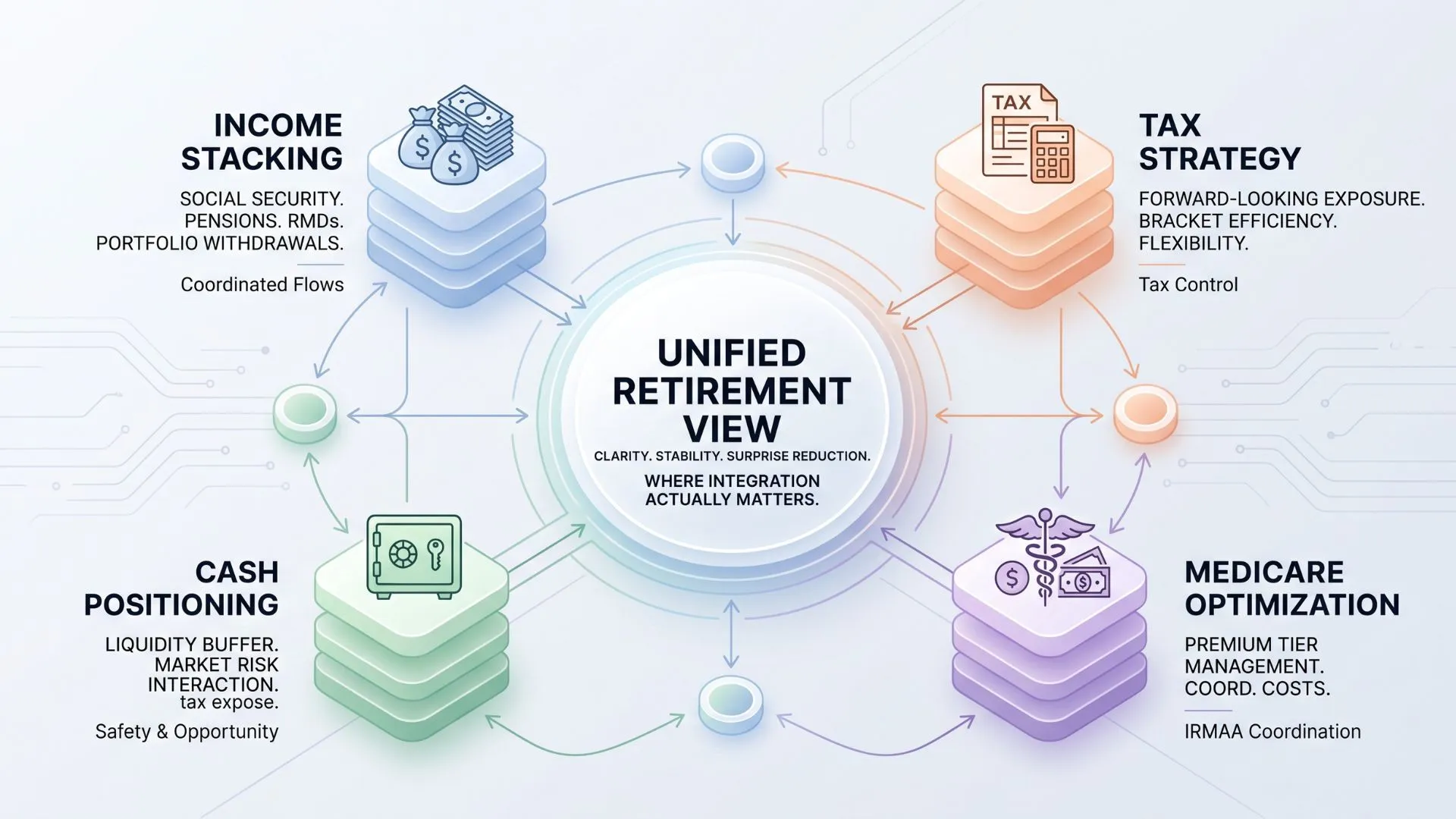
This is where true planning begins to separate from strategy selection.
Integration means stepping back and looking at all the moving pieces at once:
● How income sources stack together
● How tax decisions today affect flexibility later
● How portfolio structure supports real income needs
● How cash positioning interacts with both market risk and tax exposure
● How estate intentions align with real‑world cash flow
None of these decisions live in isolation once retirement begins.
Individually, each may be fine.
Together, they either reinforce the plan — or quietly work against it.
What an Integrated View Clarifies
When everything is viewed together, patterns become easier to see.
You can identify:
● Which years are most sensitive from a tax and Medicare standpoint
● Where income should come from first, next, and last
● Which assets are meant for stability versus long‑term growth
● Where real flexibility exists — and where it doesn’t
The goal isn’t to eliminate taxes or perfectly optimize every year.
It’s to avoid surprises that force reactive decisions.
A Reassuring Final Thought
If your taxes rose nd nothing seemed to change, that doesn’t mean something went wrong.
It usually means the system is doing exactly what it was designed to do — just without a coordinating lens.
When the full financial picture is viewed together, surprises tend to shrink and clarity improves.
And in retirement, clarity is often more valuable than any single tactic.