
Sometimes a decision can make perfect financial sense and still move you further away from the life you actually want. You can be right about the numbers, right about the risks, right about the most efficient strategy, and still overlook what the strategy was supposed to accomplish.
That can be difficult to accept, especially for people who have spent their lives making responsible decisions. But retirement eventually presents choices that cannot be measured by money alone. Because the best financial answer and the best life answer are not always identical.
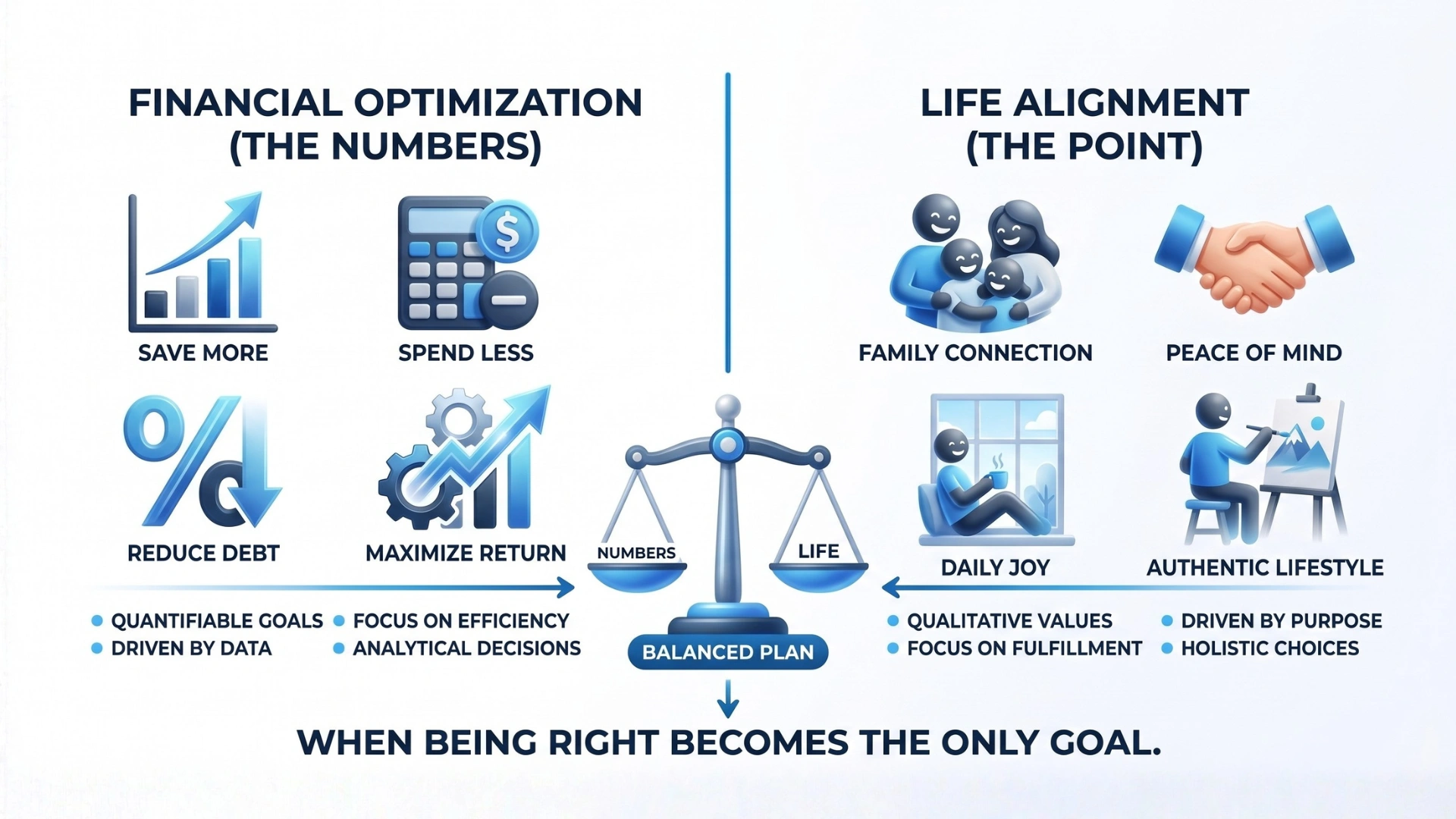
For much of our working lives, making the right financial decision can feel relatively straightforward: save more, spend less, reduce debt, invest consistently, avoid unnecessary risk. Those principles help people create security and build wealth over time.
But retirement introduces more complicated questions. Should we remain in the home we love or move somewhere less expensive? Should we preserve more for the future or use some of it to improve life today? Should we choose the option that maximizes wealth or the one that provides greater confidence?
The numbers should inform those decisions. But they should not always make those decisions for us. Because a decision can improve the financial projection while weakening the life that projection was meant to support.

Imagine a couple living in the home where they raised their family. The house is larger than they need, and property taxes and maintenance costs have increased. From a purely financial perspective, downsizing appears to be the obvious answer: sell the house, reduce expenses, release some equity, make the plan more efficient.
That recommendation may be completely right financially. But the home is also where their family gathers for holidays. It is close to lifelong friends, their doctors, their church, and the community they have known for decades. Their adult children still refer to it as home.
Selling may improve the projection. But it may also remove something that provides connection, familiarity, and meaning. The point is not that they should stay. The point is that financial efficiency is only one part of the decision. A plan that saves money but ignores what the home represents may improve the projection while making the life behind that projection feel smaller.
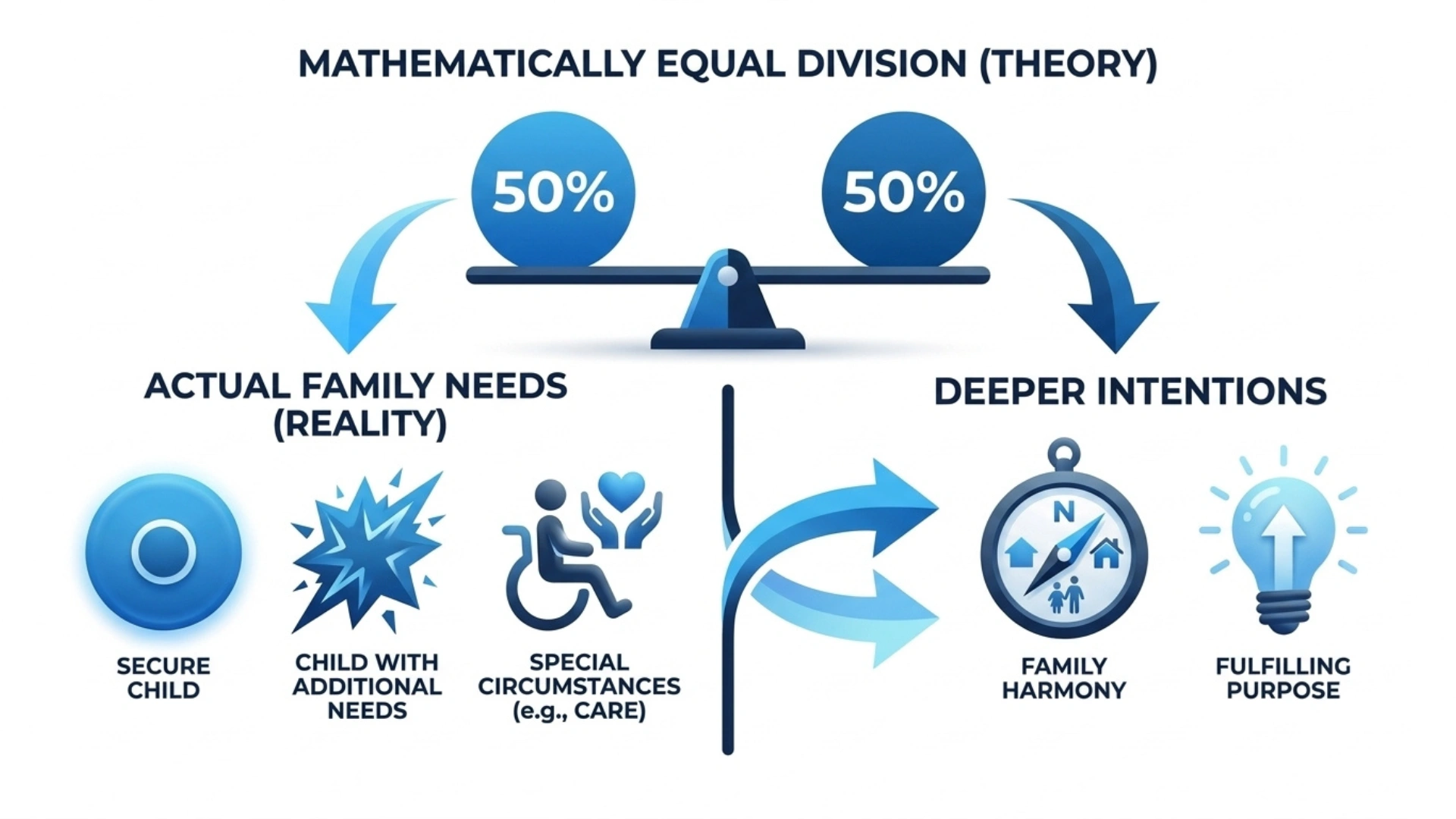
I have also seen parents become deeply focused on leaving exactly equal amounts to each child. On the surface, that feels fair. The estate documents are balanced, the percentages match, and everything is divided evenly.
But fair does not always mean identical. One child may be financially secure. Another may be caring for a family member, living with a disability, or facing circumstances that require additional support. One child may want the family property. Another may see it only as something to sell.
A mathematically equal outcome may look clean on paper without reflecting the family’s actual needs or the parents’ deeper intentions. There may be very good reasons to divide everything equally. But if equality becomes the only objective, the plan may fail to answer a more important question: what are we actually trying to accomplish for our family? You can create a mathematically equal inheritance and still leave behind questions, unintended responsibilities, or an outcome that does not reflect what you truly wanted for your family.

This can also happen with healthcare and support. A retiree may resist hiring help because doing everything independently costs less. Financially, that may be true. But perhaps maintaining the home has become exhausting. Perhaps a spouse is quietly carrying more responsibility than anyone realizes. Perhaps avoiding the expense is creating stress, limiting social activity, or taking time away from the things that make life meaningful.
The less expensive choice may preserve more money. But it may also transfer the cost somewhere else: into a spouse’s time, health, energy, or well-being.
There comes a point when the question is no longer simply, “What does this cost?” It becomes, “What does this make possible?” Help around the home might make it possible to remain independent longer. Transportation might make it possible to stay connected. Care might protect a spouse from becoming physically and emotionally overwhelmed. The expense is real. The value can be too.
Consider a business owner preparing to step away from a company built over several decades. The highest offer may come from a buyer whose plans could significantly change the company. Employees may face uncertainty. The culture may disappear. The owner’s name may remain on the building, but little else may feel familiar.
A lower offer may come from a management team committed to preserving the culture, retaining employees, and continuing the values the owner spent decades building. The highest price may be the financially efficient answer. But if the owner’s real goal includes protecting employees and preserving what was built, maximizing the sale price may not maximize what matters. You can win the negotiation and still lose the outcome you cared about most.
Financial planning involves optimization. Taxes matter, investment returns matter, fees matter, and estate efficiency matters. But every optimization has a purpose. Reducing taxes is valuable because it may preserve more resources for your life, your family, or your legacy. Growing investments is valuable because it may support future income and flexibility. Managing risk is valuable because it may help protect the life you are trying to sustain.
The danger appears when the strategy becomes more important than the person it was meant to serve. That is when people can make technically correct decisions that move them further away from what they actually wanted. The best financial outcome is not always the one with the highest number. Sometimes it is the one that creates more time, more independence, less burden on a spouse, greater family clarity, or a life that feels more aligned with what matters most.
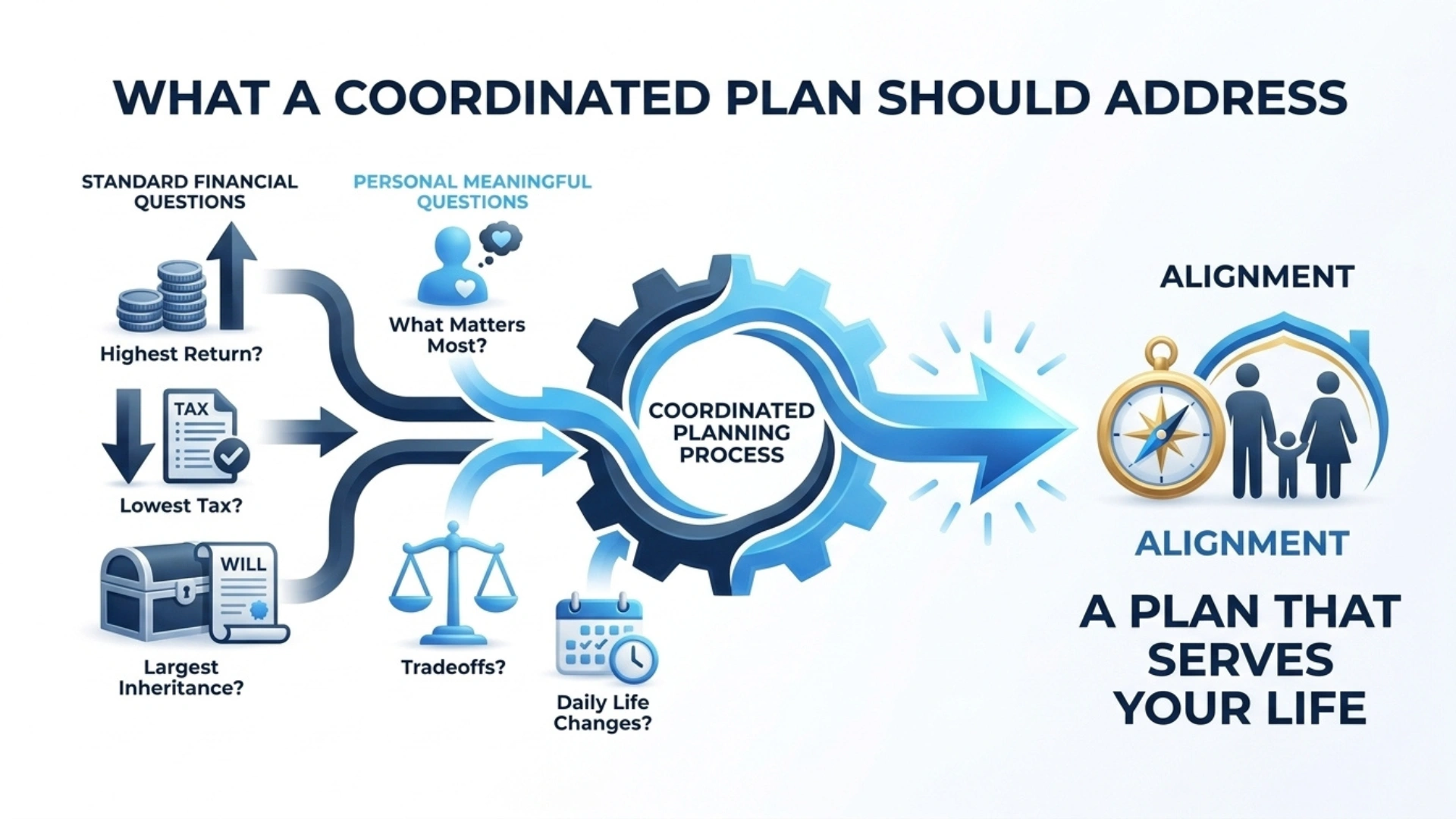
A real plan should not ask only: which option produces the highest return? Which choice creates the lowest tax bill? Which strategy leaves the largest inheritance? Which decision looks best in the projection?
It should also ask: what matters most to you? What tradeoffs are you comfortable making? What will this decision change in your daily life? Who else will be affected? What are you trying to protect? What do you want your wealth to make possible?
Those questions do not replace the numbers. They help ensure the numbers are serving the person rather than the person serving the numbers. That is why planning cannot stop at identifying the most financially efficient option. It must also connect that option to your lifestyle, family, purpose, and long-term confidence. That is where planning becomes personal, and that is where financial decisions begin supporting a life rather than simply improving a calculation. We’ve made this same case before: the right answer on paper isn’t always the right answer for your life.
You can be right about the investment and still overlook what the money was meant to support. You can be right about minimizing taxes and still create less flexibility somewhere else. You can be right about reducing expenses and still underestimate what the change may take away from your daily life. You can be right about preserving wealth and still never allow that wealth to improve the life you worked so hard to build.
That does not mean financial discipline is unimportant. It means financial decisions need context. Because the goal is not to make every dollar as efficient as possible while overlooking the person, family, and life those dollars were meant to serve.
The goal is alignment: between your resources and your values, between financial security and quality of life, between what looks best on paper and what actually matters to you.
Sometimes the most financially efficient decision will also be the right life decision. Sometimes it will not. That is why a good plan should do more than identify what works mathematically. It should help you understand what each choice makes possible, what it may take away, who else it may affect, and whether the result still reflects the life you are trying to build.
Because you can be completely right about the numbers and still miss the point. And the point was never to win on paper. It was to build a life that works in the real world.