Your portfolio’s performance is only half of the story; what you actually keep after the IRS takes its share defines your true success. It’s exhausting to reach year-end only to be blindsided by a tax bill that ignores your broader financial goals because your advisor and CPA don’t communicate. Learning how to integrate investment and tax planning is not merely an administrative task; it’s a structural necessity for 2026. This year, with shifting tax brackets and new retirement contribution limits like the $24,500 cap for 401(k) plans, a reactive approach to wealth management will inevitably erode your long-term growth.
You deserve a strategy where every trade is vetted for its tax impact before it’s ever executed. This article provides a roadmap for moving beyond basic tax preparation into a proactive “One Plan” framework that coordinates asset location and harvesting strategies. You’ll discover a methodical approach to synchronizing your holdings with the current tax landscape, ensuring your wealth remains protected for the next generation while providing you with total peace of mind that no gaps exist in your strategy.
Key Takeaways
- Understand why the traditional communication gap between your financial advisor and CPA creates “wealth leakage” and how a unified approach protects your long-term capital.
- Discover exactly how to integrate investment and tax planning to ensure that every portfolio adjustment is evaluated for its tax consequence before the trade is executed.
- Learn how to utilize advanced tools like strategic Roth conversions and Donor-Advised Funds to convert potential tax liabilities into multi-generational legacy assets.
- Identify the five critical steps to transition from reactive tax preparation to a proactive “One Plan” strategy that prioritizes maximizing your after-tax returns.
- Find out how to audit your current financial structure for “defective” gaps that lead to unexpected year-end tax surprises and inefficient asset location across your accounts.
The Silo Trap: Why Separate Investment and Tax Planning Often Fails
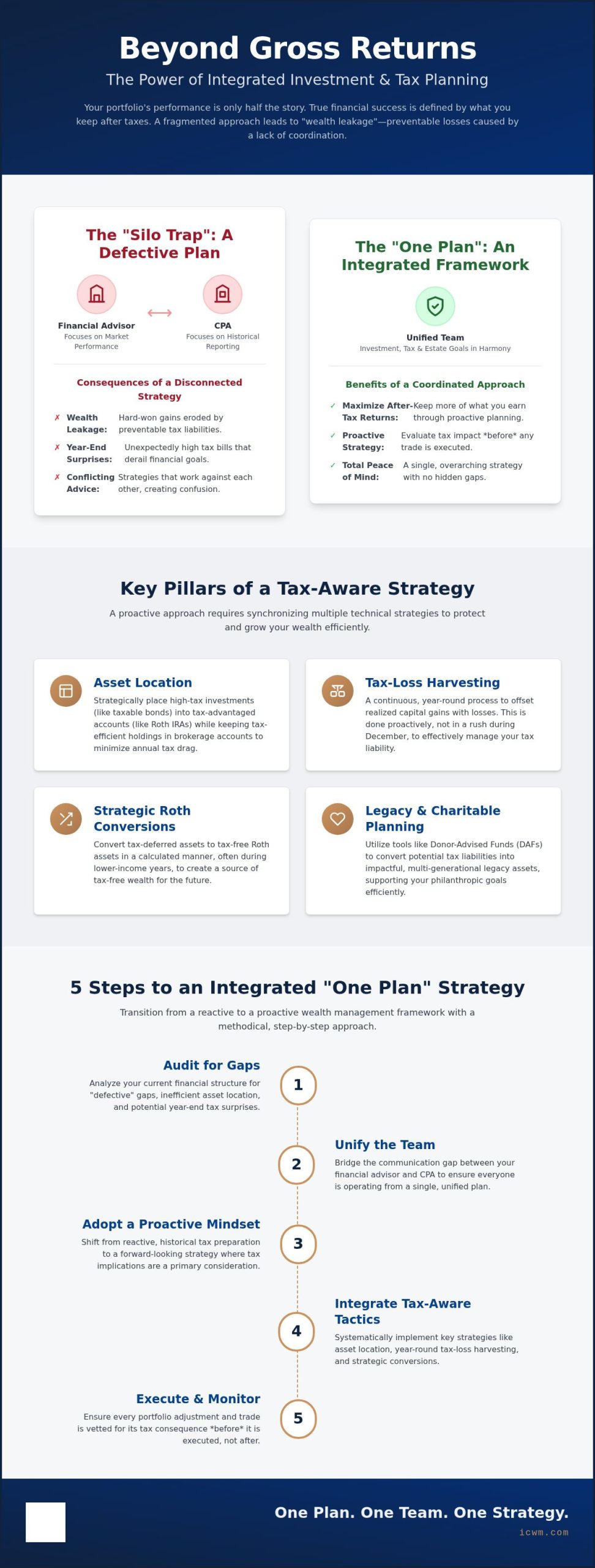
Most high-net-worth individuals operate under a fragmented financial model where their wealth manager focuses on market performance while their CPA focuses on historical reporting. This disconnect is the primary driver of wealth leakage, where hard-won gains achieved in the market are eroded by preventable tax liabilities. Learning how to integrate investment and tax planning is the only way to stop this erosion, yet large institutional banks often struggle with this coordination because their rigid structures prevent deep, cross-disciplinary collaboration. A fiduciary boutique, acting as a holistic architect, is better positioned to ensure that your financial growth isn’t compromised by a lack of professional alignment.
The Communication Gap Between CPA and Advisor
Advisors and CPAs often view the same portfolio through entirely different lenses, leading to a language barrier that costs you money. An advisor might execute a high-turnover strategy to capture short-term gains, unaware that those trades push you into a higher tax bracket or trigger the 3.8% Net Investment Income Tax. Without a unified framework, you’re essentially managing two separate plans that may actively work against each other. This is the definition of a defective plan, a vulnerability that we’ve identified and corrected for over thirty years. Siloed planning doesn’t just create technical errors; it creates a mental burden for the family caught in the middle of conflicting professional advice.
Moving from Reactive Reporting to Proactive Strategy
Standard tax preparation is inherently reactive; it’s a post-mortem analysis of what happened in the previous year. Understanding how to integrate investment and tax planning requires a forward-looking perspective where tax implications are evaluated before a trade is ever made. This One Plan approach transforms tax from a year-end surprise into a manageable variable. By coordinating with affiliated tax professionals year-round, we identify gaps before they become costly errors. Consider the impact of these proactive steps:
- Asset Location: Placing tax-inefficient assets in sheltered accounts to minimize annual hits.
- Harvesting Coordination: Matching capital gains with losses throughout the year rather than waiting until December.
- Vulnerability Assessment: Identifying trades that might trigger phase-outs for specific deductions or credits.
This level of detail-oriented management provides a sense of calm control. You’re no longer waiting for an April surprise. Instead, you’re following a structured, methodical path where every moving part is brought into harmony through a single, overarching strategy. If you’re ready to see if your current plan has these hidden gaps, it’s time to evaluate your financial fit with a team that prioritizes integration.
What is Integrated Investment and Tax Planning?
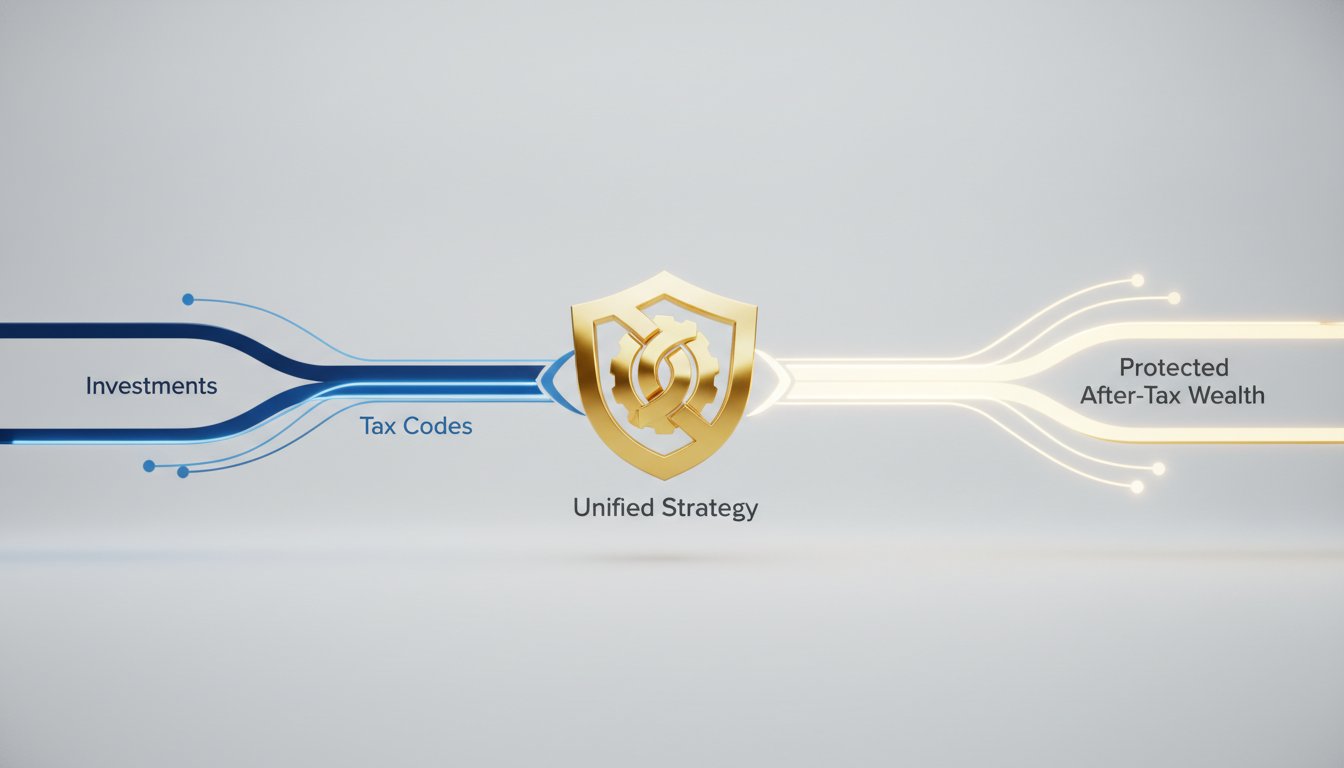
Integrated planning is the deliberate synchronization of your portfolio’s growth with the specific requirements of the tax code. It’s a unified strategy where every investment decision is vetted for its technical tax consequence before a single trade is executed. While traditional management focuses almost exclusively on gross performance, the core objective of this integrated approach is the maximization of after-tax returns. After all, your true wealth isn’t defined by what you earn, but by what you keep after fulfilling your obligations to the IRS. By adopting a “One Plan” framework, we bring investment, tax, and estate goals into a single, harmonious narrative. As a fiduciary, our role is to act as a protective guardian, ensuring that tax-aware management is applied consistently across all account types, from taxable brokerage accounts to tax-deferred IRAs.
The Primary Pillars of Tax-Aware Investment Management
To achieve total structural harmony, we focus on several key pillars that prevent wealth from leaking out of your plan. These technical actions are directly linked to the stability of your long-term legacy. By managing these moving parts with precision, we create a more secure path toward your personal life goals.
- Asset Location: We strategically place high-tax investments, such as taxable bonds or certain alternative assets, into tax-advantaged accounts like Roth IRAs, while keeping tax-efficient holdings in your brokerage accounts.
- Tax-Loss Harvesting: This is a year-round process where we offset realized gains with strategic losses, effectively lowering your taxable income and keeping more of your capital at work.
- Dividend and Distribution Management: We carefully control the timing and nature of taxable events, ensuring that distributions don’t inadvertently push you into a higher tax bracket or trigger the 3.8% Net Investment Income Tax.
The Impact of Integration on Long-Term Wealth Growth
Tax Alpha is the additional return generated purely through the meticulous, tax-efficient management of your investment portfolio over time. When tax leakage is minimized through a coordinated strategy, the power of compounding works more effectively because a larger portion of your principal remains invested. The 2026 tax environment, characterized by adjusted brackets reaching up to 37% for incomes over $640,600 for single filers, requires a level of sophisticated coordination that was perhaps less critical in simpler eras. Because the IRS adjusts thresholds and contribution limits annually, such as the $24,500 employee limit for 401(k) plans, your strategy must be as dynamic as the law itself. If you’re concerned that your current advisor is only looking at half the picture, evaluating your financial fit with a team that prioritizes integration can provide the clarity you need.
Key Strategies for Synchronizing Your Financial Plan
Achieving harmony in your financial life requires moving beyond the “silo trap” and implementing specific, technical maneuvers. One of the most effective methods for how to integrate investment and tax planning is the strategic Roth conversion. By evaluating the cost-benefit of paying taxes at today’s known rates, you can secure tax-free growth for the future. This move is particularly relevant given the 2026 single filer top bracket of 37% for income over $640,600. Charitable giving also serves as a powerful coordination tool. Using Donor-Advised Funds (DAFs) allows you to bunch contributions to exceed the 2026 standard deduction of $16,100 for single filers or $32,200 for those married filing jointly. Additionally, Qualified Charitable Distributions (QCDs) can satisfy required minimum distributions without adding to your taxable income.
Estate planning shouldn’t exist in a vacuum. It must be integrated with your tax strategy to preserve the maximum amount of wealth for your heirs. For those who want to explore Life Insurance Brokerage as a way to provide tax-free liquidity for future generations, this coordination is essential. By coordinating estate documents with tax-aware investment titles, we ensure that your legacy isn’t diminished by administrative oversights or unnecessary probate costs. This level of meticulous vetting identifies vulnerabilities before they impact your family, providing a stable foundation for multi-generational growth.
Optimizing the Great Wealth Transfer
Preparing for a multi-generational transfer of wealth requires more than just a simple will; it demands a meticulous vetting of how your assets are titled and taxed. Integrated planning ensures that your estate documents reflect your current tax-aware investment strategy, closing the gaps that often lead to defective plans. You can explore our framework for this transition in our guide on Legacy Planning: 6 Steps. This coordination provides the security of knowing your family’s future is protected by a single, cohesive strategy.
Managing Volatility with Tax-Smart Rebalancing
Market downturns, while often stressful, present a unique opportunity for a coordinated team to execute tax-loss harvesting. Instead of a reactive panic, we use volatility to capture losses that offset future gains, effectively lowering your tax liability while maintaining your target asset allocation. Our approach to Investment Strategies for Volatile Markets focuses on using these periods to strengthen your after-tax position. By rebalancing through a tax-aware lens, we ensure that every portfolio adjustment serves the dual purpose of risk management and tax optimization.
5 Steps to Integrate Your Investment and Tax Strategy
Transitioning from a fragmented financial model to a unified strategy requires a methodical, deliberate approach. It isn’t enough to simply hire talented professionals; you must ensure they are operating within a single, coordinated framework where the left hand always knows what the right hand is doing. Learning how to integrate investment and tax planning effectively starts with a shift in your professional hierarchy, moving you from the role of an exhausted intermediary to the beneficiary of a streamlined process. This progression replaces the mental burden of technical decision-making with a sense of calm control.
Step 1: The Integrated Audit
The first step in closing planning gaps is identifying where your current advisor and CPA are out of sync. You can test this coordination by asking a simple question: “What specific tax projections were used to vet my last three portfolio trades?” If your professionals only communicate during the spring tax season, your plan is likely defective. A true integrated wealth strategy review identifies vulnerabilities by analyzing how your turnover rate, dividend yield, and account titling interact with the 2026 tax brackets. This audit serves as a baseline, allowing us to identify and fix structural errors before they result in a high year-end bill.
Following the audit, the integration process continues through these critical phases:
- Consolidate the Professional Team: Move your management under a single, coordinated framework where fiduciary advisors and tax professionals share a unified vision.
- Establish a Plan-First Baseline: Ensure that your investment selection is dictated by your tax profile and long-term goals, rather than chasing gross performance in a vacuum.
- Implement Year-Round Monitoring: Move beyond reactive reporting by using a system that monitors tax-loss harvesting opportunities every month.
- Conduct Quarterly Reviews: Every performance update must be accompanied by updated tax projections to ensure your “One Plan” remains on track as your life evolves.
Special Considerations for Business Owners
For the business owner, the interconnectedness of various life factors is even more pronounced, requiring a holistic architect to manage the complexity. Integrating business exit strategies with personal tax planning is critical for preserving the value of a liquidity event, as these transitions often trigger significant capital gains liabilities. Evaluating business structures for maximum tax efficiency and asset protection must happen months, if not years, in advance of a sale. A “One Team” approach ensures that your business wealth is seamlessly transitioned into personal wealth without the friction of siloed advice, protecting your legacy and providing the freedom to focus on your next chapter.
The Confidence Wealth Solution: One Plan. One Team. One Strategy.
Confidence Wealth Management operates as a dedicated partner, acting as the holistic architect of your financial future. While traditional firms often leave the burden of professional coordination to the client, we directly coordinate with affiliated tax and estate professionals to bridge the gap between investment management and tax reporting. This “under one roof” approach ensures that how to integrate investment and tax planning isn’t just a theoretical goal but a structural reality. By bringing these moving parts into harmony through a single, overarching strategy, we eliminate the vulnerabilities that lead to wealth leakage and unexpected tax surprises. This creates a narrative where every professional service is linked to a specific life improvement for your family.
Our fiduciary boutique model is built on the belief that personalization is the foundation of security. Unlike big-box institutions that rely on standardized, product-first investing, we prioritize a “Plan-First” methodology that is meticulously tailored to your specific life goals. We’ve spent over 30 years identifying and fixing defective plans where siloed advice has created unnecessary risk. This commitment to detail-oriented vetting provides a level of stable, protective oversight that larger firms simply aren’t structured to deliver. You aren’t just another account; you’re a select client who deserves a strategy that leaves no stone unturned.
Solving Complex Financial Needs with Sophisticated Planning
Affluent families and business owners face unique challenges that require more than just basic asset allocation; for those looking to move beyond standard models, you can discover Truvestments and their specialized investment portfolios. Whether you’re managing a specialized business-exit financial plan or evaluating beneficial business structures, the interconnectedness of these factors demands a single, overarching strategy. This unified approach provides the peace of mind that comes from knowing your plan is designed to prevent failure rather than just react to it. It’s about creating a narrative where technical actions are directly linked to your family’s personal well-being and long-term legacy. By closing the gap between investment management and tax reporting, we allow you the freedom to focus on your personal life goals.
Take the First Step Toward a Unified Plan
Moving beyond siloed planning is the most significant step you can take toward protecting your multi-generational wealth. It requires a shift from the administrative burden of managing multiple professionals to the freedom of a coordinated team. A comprehensive FIT assessment allows us to evaluate your current trajectory and identify any hidden gaps in your strategy. This process isn’t just about technical evaluation; it’s about conducting the deep research necessary to ensure your wealth plan is truly unified and ethically driven. By evaluating your structural alignment, we help you transition into a state of calm control where your focus remains on your life goals rather than technical burdens.
Secure Your Legacy Through Structural Harmony
Achieving a unified wealth strategy requires more than just high-performing assets; it demands the meticulous synchronization of every financial lever at your disposal. By moving beyond the silo trap and embracing a proactive framework, you ensure that your portfolio growth remains protected from the erosion of unnecessary tax liabilities. Understanding how to integrate investment and tax planning is the definitive step toward securing the peace of mind that comes from a truly cohesive strategy.
As an SEC-registered investment adviser and fiduciary boutique, Confidence Wealth Management brings a team of over 23 professionals together to provide integrated wealth, tax, and estate coordination. We’re dedicated to closing the gaps that standard planning often overlooks, acting as a protective guardian for your multi-generational success. This methodical approach ensures that every moving part of your financial life is brought into perfect alignment.
You’ve worked hard to build your legacy. It’s time to ensure your plan is structurally sound enough to protect it for generations to come.
Frequently Asked Questions
What is the difference between tax planning and tax preparation?
Tax preparation is a reactive process focused on accurately reporting historical data to the IRS after the year has ended. In contrast, tax planning is a proactive, forward-looking strategy that identifies opportunities to minimize liabilities before they occur. By understanding how to integrate investment and tax planning, you move beyond simple compliance into a space where every financial decision is vetted for its long-term impact on your net wealth.
How does asset location differ from asset allocation?
Asset allocation refers to the specific mix of investments in your portfolio, such as stocks, bonds, and real estate, to manage risk and return. Asset location is the strategic process of deciding which type of account, such as a taxable brokerage or a tax-deferred IRA, should hold those specific investments. Proper location ensures that tax-inefficient assets are shielded from annual taxes, while tax-efficient holdings remain in accounts where they provide the most benefit.
Can integrated planning really increase my investment returns?
Integrated planning generates what professionals call Tax Alpha, which is the additional return kept after taxes are paid. By minimizing wealth leakage through strategies like tax-loss harvesting and precise asset location, a larger portion of your principal remains invested to compound over time. While gross performance is often the focus of standard advisors, your true success is measured by the after-tax growth that ultimately funds your personal life goals and legacy.
Why does my financial advisor need to talk to my CPA?
Direct communication between your advisor and CPA is essential to prevent defective plans where investment trades inadvertently trigger significant tax liabilities. When these professionals work in silos, they often miss opportunities for coordination, such as matching capital gains with losses or managing income thresholds. Learning how to integrate investment and tax planning ensures that your portfolio management and tax reporting are in total harmony, removing the mental burden of technical decision-making.
Is integrated wealth management only for business owners?
While business owners benefit significantly from specialized exit strategies and entity evaluation, integrated wealth management is vital for any affluent family with complex financial interests. High-net-worth individuals often face unique challenges, such as the 3.8% Net Investment Income Tax or phase-outs of specific deductions. Any portfolio with multiple account types and significant taxable income requires a holistic architect to ensure that all moving parts are brought into harmony through a single, overarching strategy.
How often should my integrated financial plan be reviewed?
An integrated plan should be reviewed quarterly to ensure that your investment performance and tax projections remain aligned as the year progresses. Waiting until April to discuss taxes with your CPA is a reactive approach that often leads to missed savings opportunities. Year-round monitoring allows your team to execute time-sensitive maneuvers, such as strategic Roth conversions or charitable giving, that must be completed before the calendar year ends to be effective.
What are the most common gaps in a defective financial plan?
The most frequent gaps include a lack of communication between the advisor and CPA, poor asset location across account types, and reactive tax-loss harvesting that only happens in December. Many plans also fail to coordinate estate documents with tax-aware investment titles, creating vulnerabilities during wealth transfer. Our boutique approach focuses on identifying these structural flaws through a meticulous vetting process, ensuring that your unified wealth strategy remains stable and protective over the long term.
How does the 2026 tax environment affect my current investment strategy?
The 2026 tax landscape introduces adjusted brackets and higher standard deductions, such as $32,200 for married couples filing jointly, which requires a more sophisticated coordination of your income. With the top tax rate at 37% for single incomes over $640,600, your strategy must account for these thresholds to avoid unnecessary leakage. A coordinated team will evaluate how these changes impact your retirement contributions and capital gains management, keeping your plan resilient in a shifting regulatory environment.
Disclaimer
Confidence Wealth Management Inc (CWM) is an SEC registered investment adviser. Confidence Wealth & Insurance Solutions Inc (CWIS) is licensed under the NV Department of Insurance, license no. 3647322. CWM and CWIS are two separate affiliated companies, and have no affiliation with government, state, or local agencies. Investment advisory services are provided by CWM. All insurance products and services provided by CWIS. Information presented is for educational purposes only and does not intend to make an offer or solicitation for the sale or purchase of any specific securities, investments, or investment strategies, and may not be relied on for the purpose of avoiding any federal tax penalties or obligations. All content is derived from sources believed to be accurate at time of publication. Investments involve risk and, unless otherwise stated, are not guaranteed. Past performance is not indicative of future performance. Consult with a qualified financial adviser and/or tax professional before implementing any strategy discussed herein.