What if the team of experts you’ve hired to protect your family’s future is actually the greatest risk to your legacy? You’ve likely felt the frustration of managing a collection of brilliant but disconnected professionals, where the tax strategist rarely speaks to the estate attorney and the investment manager operates in a vacuum. It’s exhausting to act as the primary coordinator for your own complex wealth when you’re simply looking for the security of a single, cohesive vision. You deserve to feel like a priority, not just another account number in a massive institution’s database.
This guide demonstrates how boutique private wealth management in 2026 functions as a holistic architect, harmonizing these separate financial pillars into one unified, gap-free strategy. You’ll discover a fiduciary approach that identifies hidden vulnerabilities and fixes defective plans before they can fail during a wealth transfer. We’ll walk through the core planning components that ensure your investments, taxes, and estate goals finally talk to each other, providing the ultimate freedom to focus on your life rather than your paperwork.
Key Takeaways
- Learn why a “Universe of One” philosophy is essential for protecting your legacy by maintaining a focused, personalized client-to-advisor ratio.
- Understand how boutique private wealth management eliminates the structural “silo effect” of large banks, ensuring your tax and investment strategies work in harmony.
- Discover the seven core pillars of integrated planning that move beyond simple investment management to address your entire financial ecosystem.
- Learn how to identify “defective” areas in your current strategy, such as exposed assets or outdated estate documents, before they compromise your long-term goals.
- Gain a framework of critical questions to evaluate a potential partner’s ability to coordinate complex wealth strategies under a single, fiduciary-led vision.
What is Boutique Private Wealth Management?
Boutique private wealth management is a specialized, fiduciary-led advisory model designed for individuals with significant liquid assets, often exceeding the $1 million threshold for high-net-worth status. Unlike massive retail banks that prioritize quarterly sales targets and proprietary product distribution, a boutique firm operates under a “Universe of One” philosophy. This approach deliberately limits the client-to-advisor ratio so that your lead architect can dedicate the time required to understand the intricate nuances of your family’s legacy. It’s a relationship built on the premise that your financial strategy should be as unique as the life it supports, moving away from standardized models toward a deeply personalized framework that values stability over speculative trends.
The Fiduciary Distinction
The core of this model is the fiduciary standard, which is a legal and ethical obligation to act in your best interest at all times. In the current regulatory environment of 2026, where the SEC and CFTC are demanding more granular proof of fiduciary care, this distinction has never been more critical for protecting your assets. While many large brokerage houses operate under a “suitability standard,” which only requires that a recommendation be appropriate for your situation at the time of sale, a fiduciary must prioritize your needs above their own or their firm’s profits. This structural safeguard eliminates the hidden incentives that often lead to product-pushing in larger institutions. A boutique setting provides the natural environment for true fiduciary work because the firm’s success is directly tied to your long-term security, rather than the volume of transactions processed or the sale of in-house investment products.
Personalization Beyond the Portfolio
True wealth management extends far beyond the selection of stocks and bonds. It requires an architect who can look across your entire financial landscape to ensure that your business-exit strategies, tax liabilities, and estate plans are perfectly aligned. You can explore a broader definition of What is Wealth Management? to see how these disciplines intersect, but in a boutique context, this integration is handled with meticulous detail. We define boutique wealth management as a harmonized strategy that bridges the gaps between siloed financial pillars to protect the complex lives of high-net-worth families. By coordinating these moving parts, your advisor moves from being a mere service provider to a protective guardian of your family’s future. This level of care ensures that your financial plan isn’t just a collection of accounts, but a living strategy that evolves alongside your personal goals and business milestones, providing you with the freedom to focus on your life rather than the administrative burdens of your wealth.
Boutique vs. Big Bank: The Structural Conflict
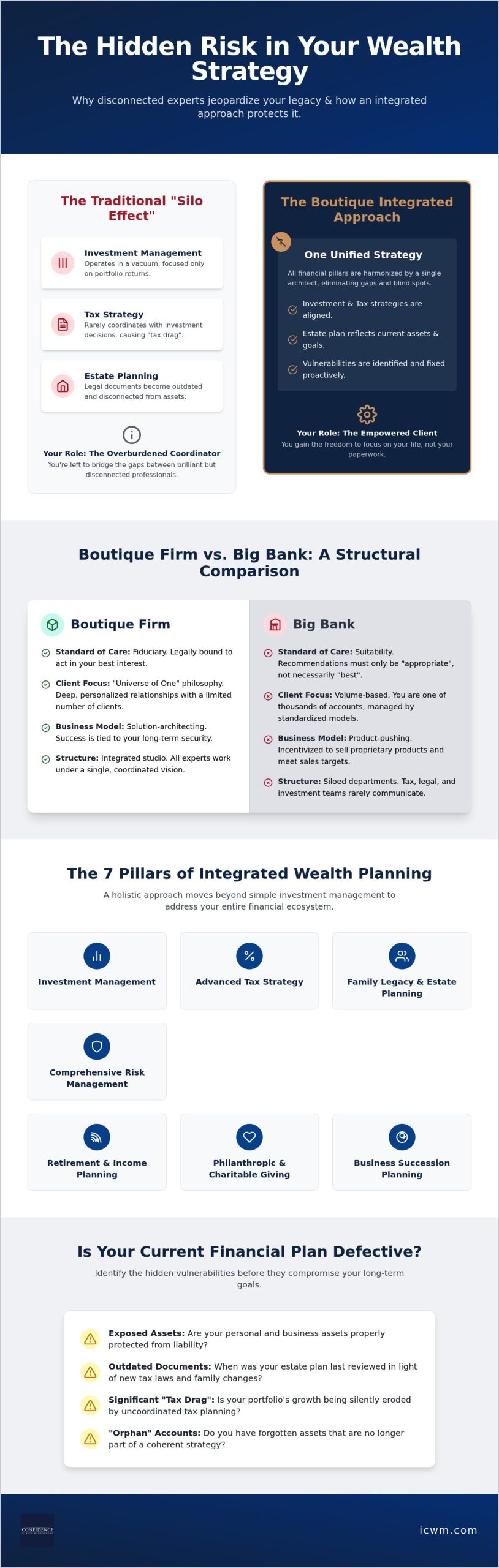
Large financial institutions often operate like massive industrial machines where efficiency and scale are prioritized over the intricate needs of a single family. This structural design inevitably creates a “Silo Effect,” a situation where tax planning, legal coordination, and investment management exist in entirely different departments that rarely communicate. In such an environment, the professionals managing your wealth may never sit in the same room, let alone share a unified vision for your legacy. This lack of integration forces you to act as the primary coordinator, adding a technical and administrative burden that your wealth should have originally alleviated.
By contrast, boutique private wealth management is structured as an integrated studio where every professional service is linked to a specific life improvement through constant coordination. Because these firms aren’t beholden to quarterly sales targets or proprietary product quotas, they can focus on solution-architecting rather than product-pushing. This agility allows a boutique partner to adapt more quickly to the shifting tax laws of 2026, ensuring that your strategy remains protective and long-term oriented despite market volatility.
The Risk of Siloed Advice
When your CPA and investment advisor don’t coordinate, the resulting “tax drag” can silently erode your portfolio’s growth over decades. A common danger in the big bank model is the creation of “orphan” accounts, which are assets that were once part of a strategy but have since been forgotten or left uncoordinated with new estate documents. Large banks struggle to provide a unified financial strategy because their internal incentives often favor the distribution of products over the meticulous vetting of a client’s external tax and legal pillars. To better understand the professional standards that should govern these relationships, you may find this Private Wealth Management Overview from the CFA Institute to be a valuable resource.
Transparency and Fee Structures
Transparency is the foundation of a reassuring partnership, yet it’s often obscured in institutional models by commission-heavy structures that can cloud an advisor’s motivations. Boutique firms typically utilize fee-based or flat-fee models, ensuring you know exactly what you’re paying for and why. This clarity builds a sense of calm control, as you’re no longer wondering if a recommendation is driven by your best interest or a hidden corporate incentive. If you feel your current plan has become a collection of disconnected parts, it’s likely time to evaluate your existing wealth structure for potential gaps. Moving from a call-center environment to a dedicated partner relationship transforms wealth management from a source of stress into a source of peace of mind.
The 7 Pillars of Integrated Wealth Planning
A truly effective financial strategy is not a static document but a living architecture where every component is designed to support the others. While many firms offer a “comprehensive” approach, boutique private wealth management distinguishes itself through the meticulous coordination of seven core planning pillars. This framework ensures that no single decision is made in isolation, preventing the common failure where a successful investment strategy inadvertently creates a massive tax liability or an estate plan that cannot be executed because of improper asset titling. By bringing these moving parts into harmony, we create a defensive shield around your legacy, allowing you to move forward with the confidence that your wealth is being managed with professional sophistication.
Core Components of a Unified Strategy
The foundation of this architecture begins with investment management that aligns your specific risk tolerance with long-term life goals. However, this is only the starting point. To protect your returns, we prioritize tax planning coordination, which involves a proactive dialogue with affiliated tax professionals to minimize your lifetime tax liability through strategies like intelligent investment harvesting. This ensures that your tax return completion is not just a backward-looking administrative task but a forward-looking strategic tool. Similarly, estate planning coordination verifies that your legal documents are perfectly aligned with how your assets are titled, closing the dangerous gap where high-quality legal paperwork fails because the underlying accounts weren’t properly structured to follow the plan.
Asset protection planning forms the final layer of this defensive strategy, focusing on safeguarding your family’s legacy from the threats of frivolous lawsuits or creditors. By evaluating your entire financial ecosystem, a boutique partner identifies vulnerabilities that standard plans often overlook, ensuring that the wealth you’ve spent a lifetime building remains secure for the generations that follow. This holistic security often extends to the physical protection of your home; for those looking to secure their property, you can check out Compass Fence Co.
Specialized Strategies for Business Owners
For high-net-worth families whose wealth is tied to a private enterprise, the complexity of planning increases exponentially. We focus on specialized business wealth strategies and specialized business-exit financial planning to ensure that a future liquidity event is both tax-efficient and protective of the family’s long-term interests. This involves a rigorous beneficial business structures evaluation to determine if your current entity setup is optimized for asset protection and future transition. By addressing the “business owner gap,” where personal financial goals and professional wealth are often uncoordinated, we help you transition from being a successful operator to a steward of a multi-generational legacy. This holistic oversight ensures that your business serves your life goals, rather than your life being consumed by the administrative burdens of your business.
Fixing Defective Plans: Identifying the Gaps
A defective plan is rarely the result of incompetence, but rather the natural byproduct of fragmentation. High-net-worth families often possess high-quality legal documents and sophisticated investment portfolios that, when viewed in isolation, appear perfectly sound. However, when these components fail to communicate, the strategy as a whole becomes vulnerable to failure during critical life transitions or wealth transfers. In the specialized world of boutique private wealth management, we act as a protective guardian to identify where your tax strategy, estate plan, and asset titling have drifted out of alignment, creating unnecessary risk for your legacy.
The cost of plan failure isn’t merely financial; it’s the loss of the peace of mind you’ve worked decades to secure. For families with significant assets, “good enough” planning isn’t sufficient because the complexity of the current regulatory environment leaves no room for uncoordinated strategies. By identifying and repairing these vulnerabilities now, you ensure that your wealth serves as a stable foundation for your family rather than a source of future administrative burden or legal conflict.
The Plan Audit Process
Through a rigorous vetting process, we systematically examine every existing document to ensure total alignment with your current objectives and the 2026 tax landscape. This audit involves closing the dangerous gaps between what your attorney drafted and what your investment advisor is executing, such as verifying that trust provisions are actually reflected in how your accounts are titled. We also look for “defective” strategies, like tax-inefficient portfolios or exposed assets, that no longer serve your interests under new ERISA safe harbor regulations or updated filing thresholds. If you’re concerned that your current strategy has become a collection of disconnected parts, you can request a detailed audit of your existing planning pillars to restore harmony to your financial life.
Case Study: The Integrated Solution
Consider the scenario of a business owner preparing for a specialized business-exit financial planning event. While their company was highly successful, their personal estate documents hadn’t been updated in years, and their investment portfolio was managed without regard for the massive tax liability the business sale would trigger. This lack of coordination created a “business owner gap” that threatened to erode a significant portion of their hard-earned liquidity. By performing a beneficial business structures evaluation and harmonizing their professional exit strategy with their personal tax and estate pillars, we were able to create a single, unified strategy that protected the proceeds and secured their family’s future.
This transformation from a fragmented plan to an integrated one provided the client with the freedom to focus on their next chapter without the mental weight of uncoordinated technical details. Integrated planning serves as the ultimate filter for complexity, distilling a multitude of moving parts into a single, serene path forward for your family.
Selecting Your Boutique Wealth Partner
Choosing a partner to steward your family’s legacy is a decision that requires looking beyond investment performance to the underlying architecture of the firm’s service model. When evaluating a potential advisor, it’s essential to ask how they facilitate the communication between your various financial pillars. You should prioritize a firm that operates under a fiduciary standard at all times, ensuring their recommendations are legally bound to your best interests. A true leader in boutique private wealth management will have a defined process for identifying the “defective” areas of your current strategy, such as uncoordinated tax harvesting or outdated estate titling, rather than simply accepting your existing plan at face value.
It’s also critical to evaluate the firm’s coordination model. Some boutiques operate on a “referral-only” basis, where they simply provide a list of names and leave the administrative burden of communication to you. A more protective approach involves direct coordination with affiliated tax and estate firms, where your wealth manager acts as the central hub of information. This ensures that every technical action, from a portfolio rebalance to a change in a trust document, is executed with a full understanding of the broader strategy. Transitioning your wealth is a methodical process; the first 90 days are particularly vital for performing a deep-tissue audit to fix vulnerabilities before they can lead to plan failure.
The Confidence Wealth Management Approach
We believe that your financial life deserves a holistic architect who can bring every moving part into a state of perfect alignment. Our commitment to sophisticated coordination means we don’t just manage your assets; we evaluate your entire ecosystem to ensure your investment management, tax planning coordination, and estate planning coordination are working in harmony. By utilizing our 7-pillar approach, we identify and repair the gaps that often exist in standard strategies, providing you with a sense of calm control. This protective guardian persona is the foundation of our partnership, offering you the peace of mind that your legacy is being built on a stable, long-term framework designed specifically not to fail.
Your Next Steps Toward Harmony
The path to a unified financial strategy begins with a thorough evaluation of your current vulnerabilities. We offer a meticulous plan audit to identify the specific areas where your tax, legal, and investment pillars may have drifted apart. This process allows you to see exactly where your strategy stands and how a more integrated approach can alleviate the mental burden of managing complex wealth. When you’re ready to move from a collection of disconnected accounts to a single, harmonized vision, we invite you to Schedule your integrated wealth strategy session with Confidence Wealth Management. Taking this step ensures that your wealth serves your life goals, providing the security and freedom you’ve worked so hard to achieve.
Securing Your Family’s Financial Harmony
True financial security is found when the technical pillars of your wealth, including investment, tax, and estate, are brought into a single, coordinated architecture. We’ve explored how boutique private wealth management offers a protective alternative to the siloed advice of large institutions by focusing on identifying and repairing the vulnerabilities that often exist in standard strategies. By moving toward a model where every professional service is linked to a specific life improvement, you gain the freedom to focus on your personal goals while we act as the holistic architect of your legacy.
Confidence Wealth Management is a fiduciary boutique specializing in the complex needs of high-net-worth families and business owners across the nation. Our approach brings tax and estate planning coordination under one unified architecture, ensuring no gaps remain in your financial strategy. If you’re ready to move from a collection of disconnected parts to a harmonized vision, we invite you to Request an Integrated Plan Audit from Confidence Wealth Management. It’s time to experience the peace of mind that comes from a plan designed not to fail. You deserve a partner who prioritizes your security as much as you do.
Frequently Asked Questions
What is the difference between a boutique firm and a large investment bank?
The primary difference lies in the structural approach to advice, as boutique firms prioritize a fiduciary standard while big banks often operate under a suitability standard focused on product distribution. Boutique private wealth management offers a personalized client-to-advisor ratio that allows for a unified strategy, whereas large institutions typically keep tax, legal, and investment services in separate, uncoordinated departments. This integrated architecture ensures that your lead advisor acts as an architect rather than a salesperson.
Is boutique wealth management more expensive than traditional firms?
Boutique firms often provide greater fee transparency through models that align the advisor’s success with your portfolio’s long-term growth. While big banks may appear less expensive on the surface, they often include hidden costs or proprietary product commissions that aren’t present in a fiduciary boutique model. The true value is found in the removal of “tax drag” and “plan failure” costs that uncoordinated strategies frequently incur, which can save a family significant wealth over generations.
How does a boutique firm handle tax and estate planning without being a law firm?
What are the 7 critical components of an integrated financial plan?
An integrated strategy covers seven essential pillars: financial goal setting, investment management, tax planning coordination, retirement income planning, risk management, estate and legacy planning, and business wealth strategies. By addressing these components through a single architecture, a boutique firm ensures that a success in one area, such as a high-return investment, doesn’t create a vulnerability in another, like an unexpected tax liability. This thoroughness creates a feeling of being in safe, capable hands.
Can a boutique firm handle complex business exit strategies?
Yes, specialized business-exit financial planning is a core competency of boutique firms that focus on high-net-worth families. We evaluate beneficial business structures to ensure that your company is optimized for a future liquidity event, maximizing asset protection and tax efficiency. This coordination bridges the “business owner gap” by aligning your professional exit with your personal long-term financial goals, ensuring the transition is as seamless and protective as possible.
What does it mean to have a “defective” financial plan?
A defective plan occurs when individual financial components are high-quality but fail to work as a harmonized whole. For example, you might have a sophisticated trust drafted by a top attorney, but if your investment accounts aren’t titled to reflect that trust, the plan is defective and will likely fail during a wealth transfer. Identifying these gaps is a primary focus of boutique private wealth management, as we aim to fix vulnerabilities before they compromise your family’s future.
How do boutique firms protect assets from lawsuits?
Asset protection planning involves identifying vulnerabilities in your current structure and implementing strategies to shield your legacy from frivolous lawsuits or creditors. This process often includes a beneficial business structures evaluation to ensure your enterprise doesn’t expose your personal wealth to professional liabilities. By vetting these areas proactively and coordinating with legal affiliates, we create a defensive shield around the assets you’ve spent a lifetime building, providing the security you deserve.
Is my money as safe with a boutique firm as it is with a major bank?
Your assets are typically held by major third-party custodians, providing the same institutional-grade security and insurance found at the world’s largest banks. The boutique firm manages the strategy and coordination of those assets as a fiduciary, but it doesn’t take physical possession of your funds. This structure offers the personalized care of a private partner with the technical safety of a global financial institution, ensuring your wealth is protected by both strategic oversight and physical security.
Disclaimer
Confidence Wealth Management Inc (CWM) is an SEC registered investment adviser. Confidence Wealth & Insurance Solutions Inc (CWIS) is licensed under the NV Department of Insurance, license no. 3647322. CWM and CWIS are two separate affiliated companies, and have no affiliation with government, state, or local agencies. Investment advisory services are provided by CWM. All insurance products and services provided by CWIS. Information presented is for educational purposes only and does not intend to make an offer or solicitation for the sale or purchase of any specific securities, investments, or investment strategies, and may not be relied on for the purpose of avoiding any federal tax penalties or obligations. All content is derived from sources believed to be accurate at time of publication. Investments involve risk and, unless otherwise stated, are not guaranteed. Past performance is not indicative of future performance. Consult with a qualified financial adviser and/or tax professional before implementing any strategy discussed herein.