
Most people think about taxes once a year.
They gather documents, send everything to their CPA, sign their return, and hope the bill isn’t worse than expected.
That works fine if you’re only thinking about filing taxes.
But retirement tax planning is different.
Because the biggest tax decisions usually aren’t made in April.
They’re made years earlier through income decisions, withdrawal decisions, Roth conversion decisions, and how those choices are connected over time.
And while taxes may seem like their own category, they rarely stay that way.
They eventually affect everything else.
Why Tax Planning Feels Manageable at First

One of the reasons this catches so many people off guard is that the early years of retirement often feel pretty comfortable.
Income is lower.
Taxes seem manageable.
And because nothing feels urgent, it’s easy to assume everything is working the way it should.
Many people look around and think:
“We’re probably in pretty good shape tax-wise.”
And for a while, that may even be true.
But retirement doesn’t stay static.
Where Taxes Start to Sneak Up
This is where I see a lot of people get caught off guard. Those comfortable early years don’t announce when they’re ending. Over time:
● Social Security begins
● Required minimum distributions eventually arrive
● Investment income grows
● Withdrawals increase as spending needs change
Individually, none of these seem like a problem. The challenge is that they begin stacking on top of one another. And that’s when people start asking questions like:
● “Why is my tax bill suddenly so much higher?”
● “Why am I paying more tax now than I expected in retirement?”
● “Why did my Medicare premiums go up?”
By that point, the issue usually isn’t what happened that year.
It’s the decisions that were, or weren’t, made years earlier.
The Cost of Waiting
One of the hardest parts about tax planning is that the consequences are delayed. If someone doesn’t do proactive planning this year, there usually isn’t an immediate penalty.
Nothing breaks.
Nothing feels wrong.
Life goes on.
And that’s exactly what makes it so easy to postpone.
But five or ten years later, the effects begin showing up.
● Larger required minimum distributions.
● Higher taxable income.
● Less control over where income comes from.
● Fewer opportunities to make meaningful adjustments.
● Less flexibility.
And that’s what makes tax planning so different from tax preparation.
The opportunity often exists years before the problem appears. By the time the pain becomes visible, many of the best opportunities to reduce it are already gone.
Filing Taxes and Planning Taxes Are Not the Same Thing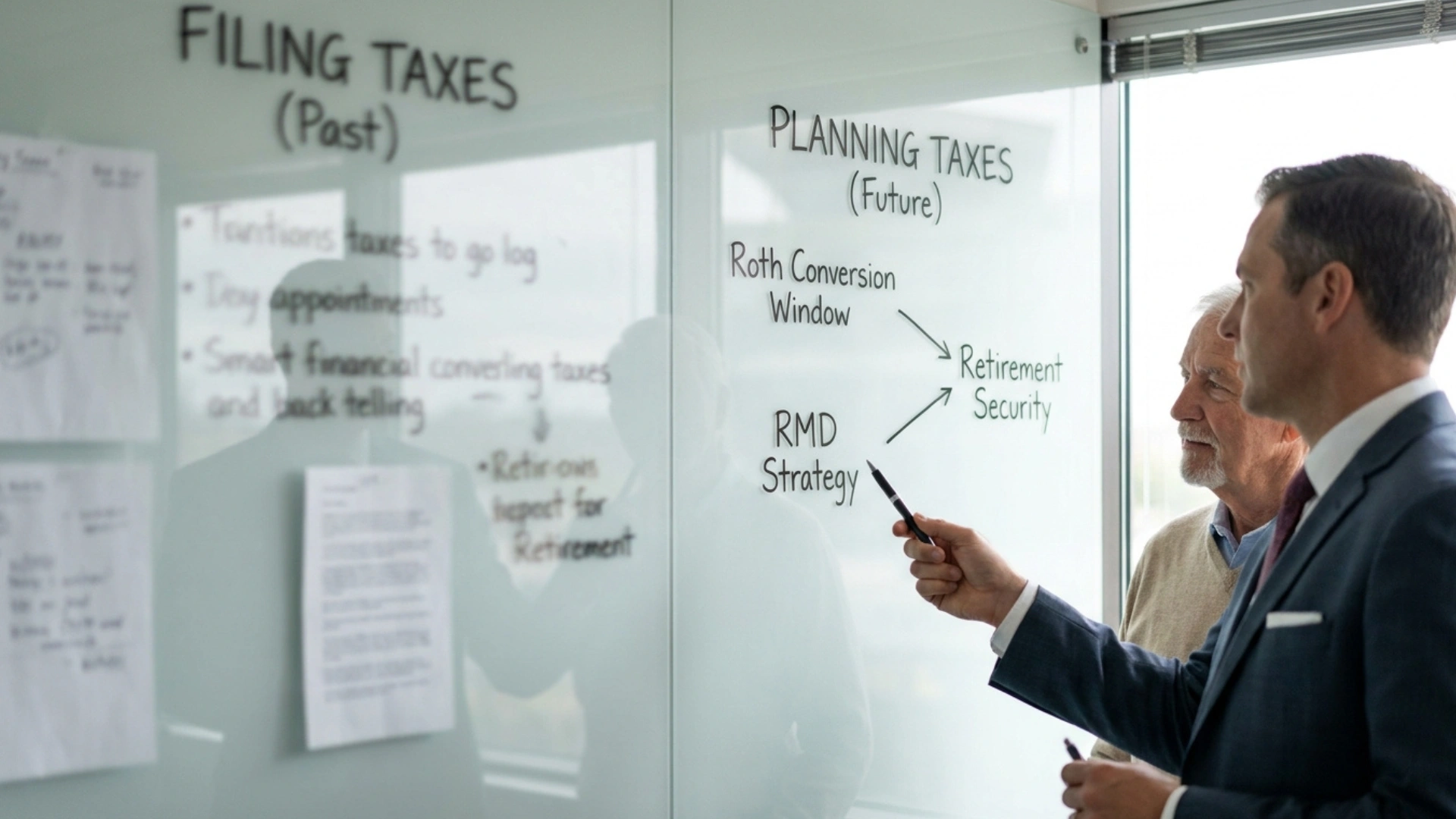
This is an important distinction.
Filing taxes is about reporting what already happened.
Planning taxes is about shaping what happens next.
That includes decisions like:
● When income should be taken
● Where withdrawals should come from
● Whether Roth conversions make sense
● How much taxable income should show up in certain years
● How today’s decisions affect future flexibility
One is reactive. The other is proactive.
And in retirement, that difference can become significant over time.
Why Taxes Don’t Exist in Isolation
One of the biggest misconceptions in retirement is thinking taxes are their own category.
They’re not.
A withdrawal decision affects taxes.
Taxes affect net income.
Net income affects spending flexibility.
Spending flexibility affects how much pressure gets placed on the portfolio.
And that portfolio is also supporting future income needs.
That’s why one tax decision rarely stays a tax decision.
It creates ripple effects throughout the rest of the plan.
When those ripple effects aren’t considered, retirement starts becoming more reactive than intentional.
Where the Real Opportunity Usually Exists
For many retirees, the greatest tax-planning opportunities exist before income begins stacking together.
Before:
● Social Security is fully online
● Required minimum distributions begin
● Multiple income sources start competing for the same tax brackets
Those years often provide a window of flexibility.
A window to evaluate:
● income timing
● Roth conversion opportunities
● withdrawal strategies
● and future tax exposure
But that window is easy to miss if the plan is being viewed one year at a time.
And once it closes, the conversation often changes from:
“How do we create flexibility?” to “How do we manage what is already coming?”
Those are very different conversations.
What Happens When Tax Decisions Aren’t Coordinated
When tax decisions are handled in isolation, plans tend to drift.
Not because anyone was reckless.
And not because someone made a terrible decision.
More often, it’s because a series of reasonable decisions were never connected together.
This is where people begin to experience things like:
● Larger tax bills than expected
● Less flexibility around withdrawals
● Higher Medicare costs
● Missed Roth conversion opportunities
● Greater RMD pressure
● More uncertainty around income decisions
Individually, none of these seems catastrophic.
But together, they create something many retirees never expected:
A plan that feels harder to manage than it should.
This is often where people realize the decisions they made were reasonable on their own, but were never integrated into a larger strategy.
What a More Coordinated Approach Changes
An integrated tax strategy isn’t about trying to beat the tax code every year.
It’s about helping decisions work together.
It means understanding:
● what income should show up this year
● how that affects future years
● where withdrawals make the most sense
● and whether today’s decision creates or reduces flexibility later
Because retirement isn’t just about minimizing taxes this year.
It’s about understanding how today’s choices shape tomorrow’s options. When those decisions are designed as one structure, things start to feel different.
Not necessarily simpler.
But clearer.
More intentional.
And easier to navigate.
A Final Thought
Most people don’t wake up one day and suddenly have a tax problem.
What usually happens is much quieter.
A series of reasonable decisions are made over time.
Income starts coming from different places.
Taxable income gradually increases.
Options become more limited. And eventually people find themselves wondering:
“How did we get here?”
The answer is rarely one bad decision.
It’s usually the space between decisions that seemed unrelated at the time.
That’s why tax planning isn’t just for April.
It’s part of a much bigger conversation about income, withdrawals, investments, and how those pieces work together over time.
Because when tax decisions are integrated early, they often create flexibility later.
And in retirement, flexibility is one of the most valuable assets you can have.